
VANCOUVER, 11 November 2026 — The Lions Gate Bridge opened for public use on Saturday 12 November 1938, when people walked across in a sleet storm, according to archive research by the Lions Gate Bridge Museum, now open online at lionsgatebridge.org. Four different dates are given for the bridge’s opening. The museum’s reading of the newspapers, film and company records of the time shows that 12 November came first, which makes Thursday 12 November 2026 the bridge’s 88th Birthday.
Four dates, one birthday
- Saturday 12 November 1938: people on foot. The Vancouver Sun reported that day that the bridge had “opened to pedestrian traffic today in a driving sleet storm”. About 1,200 people paid the pedestrian toll that Saturday and 5,750 on the Sunday, the bridge company said.
- Monday 14 November 1938: cars. The company kept cars off for two days so the pavement on the North Shore approach could set. The Canadian Encyclopedia gives this as the day the bridge opened to traffic, and in 2012 BC’s transportation ministry marked the bridge’s birthday on 14 November on its TranBC blog.
- Friday 26 May 1939: the company’s ceremony. Parks Canada gives this as the official opening.
- Monday 29 May 1939: the royal drive. King George VI and Queen Elizabeth drove across on their way to the steamer for Victoria, and did not stop. The Canadian Encyclopedia calls this the official opening.
What the records of 1938 and 1939 show
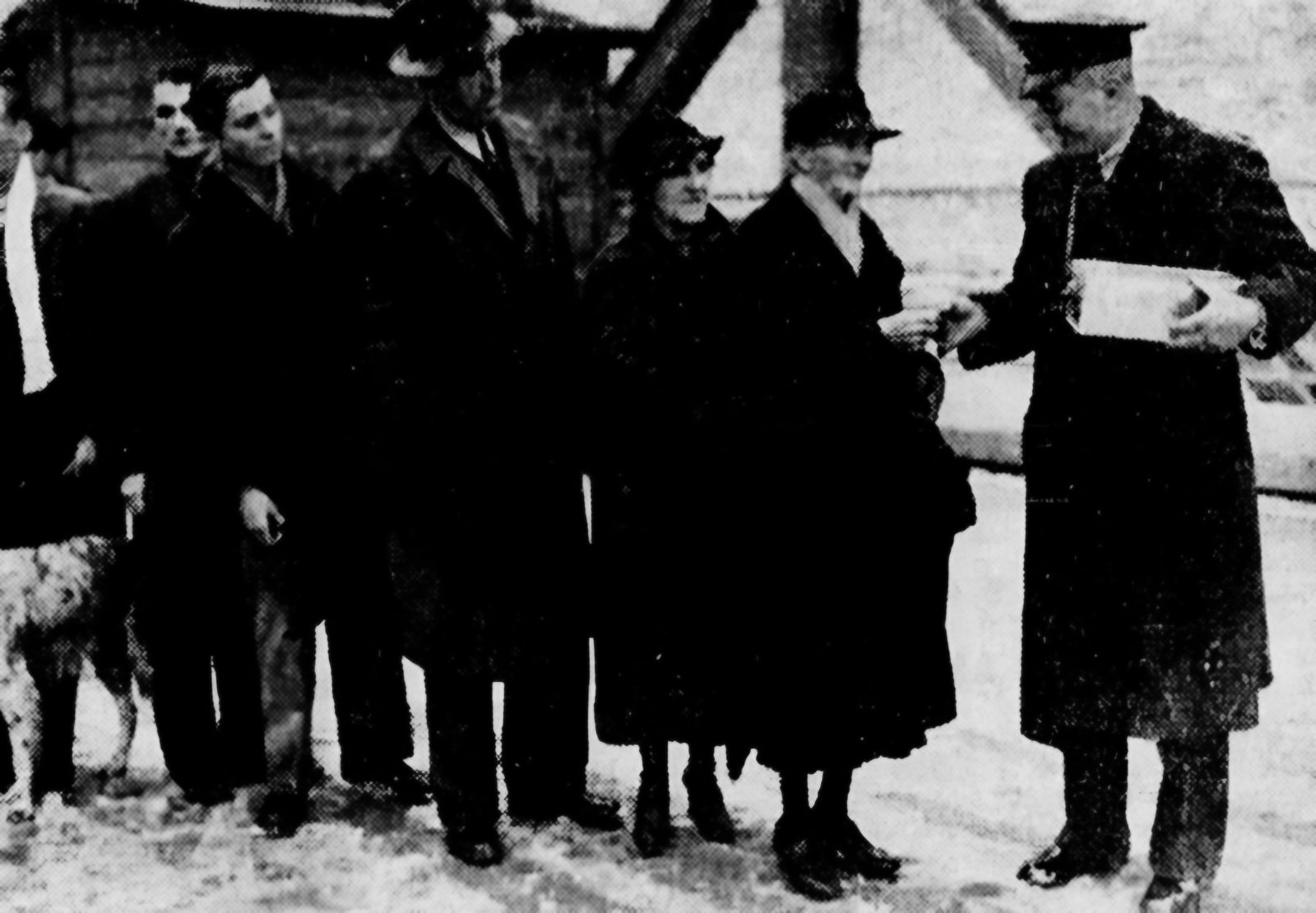
On 3 November 1938, the bridge company set the opening for people on foot at 9 a.m. on 12 November. Three records made at the time give that date: the Province’s front page of that morning, above, and these two.
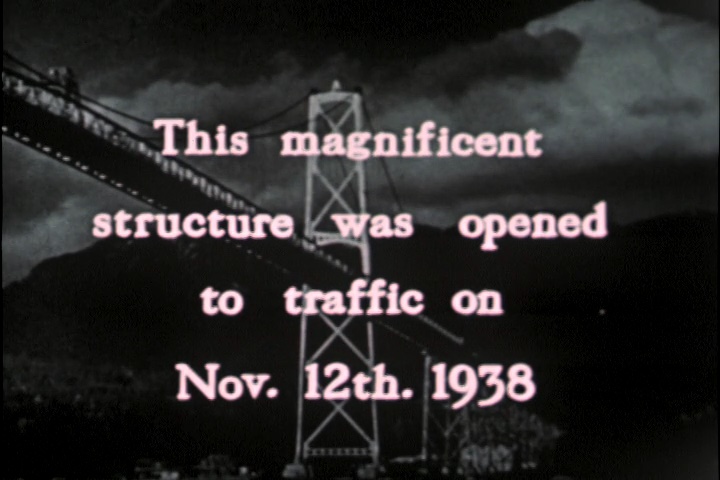
The colour film of the construction, made by the bridge’s promoter A.J.T. Taylor and now held by the City of Vancouver Archives, ends on a title card: “This magnificent structure was opened to traffic on Nov. 12th. 1938”.
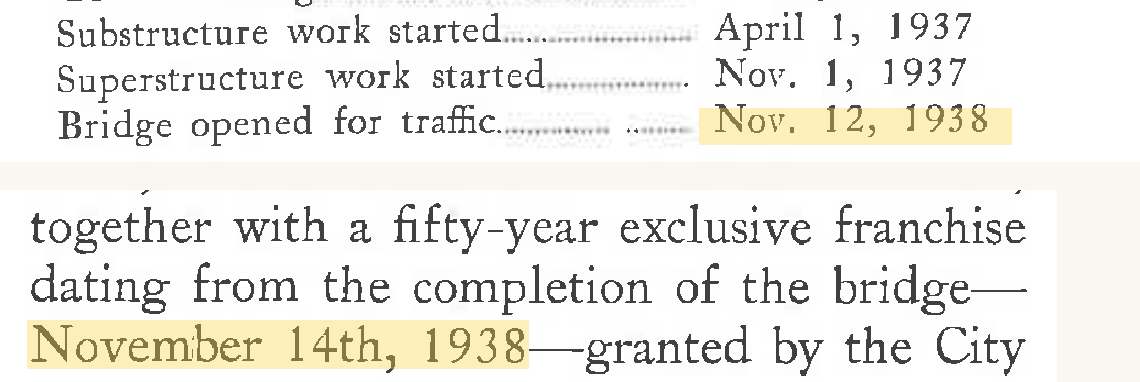
A 1939 booklet about the bridge lists “Bridge opened for traffic: Nov. 12, 1938”. It dates the company’s franchise, its right to run the bridge as a business, from 14 November, the day cars and car tolls began.
The most comprehensive online record of the bridge
The Lions Gate Bridge is one of Canada’s best-known landmarks and a National Historic Site of Canada. Vancouver voted for it in the Depression, when it was sold as work for the unemployed; at the peak, 334 people worked on it. British money paid for it. In 2000–2001 its deck was rebuilt at night while the city kept crossing by day. Ships bound for the inner harbour still pass beneath it. Its story belongs to everyone who has crossed it, but it has been scattered across newspapers, films and archive files.
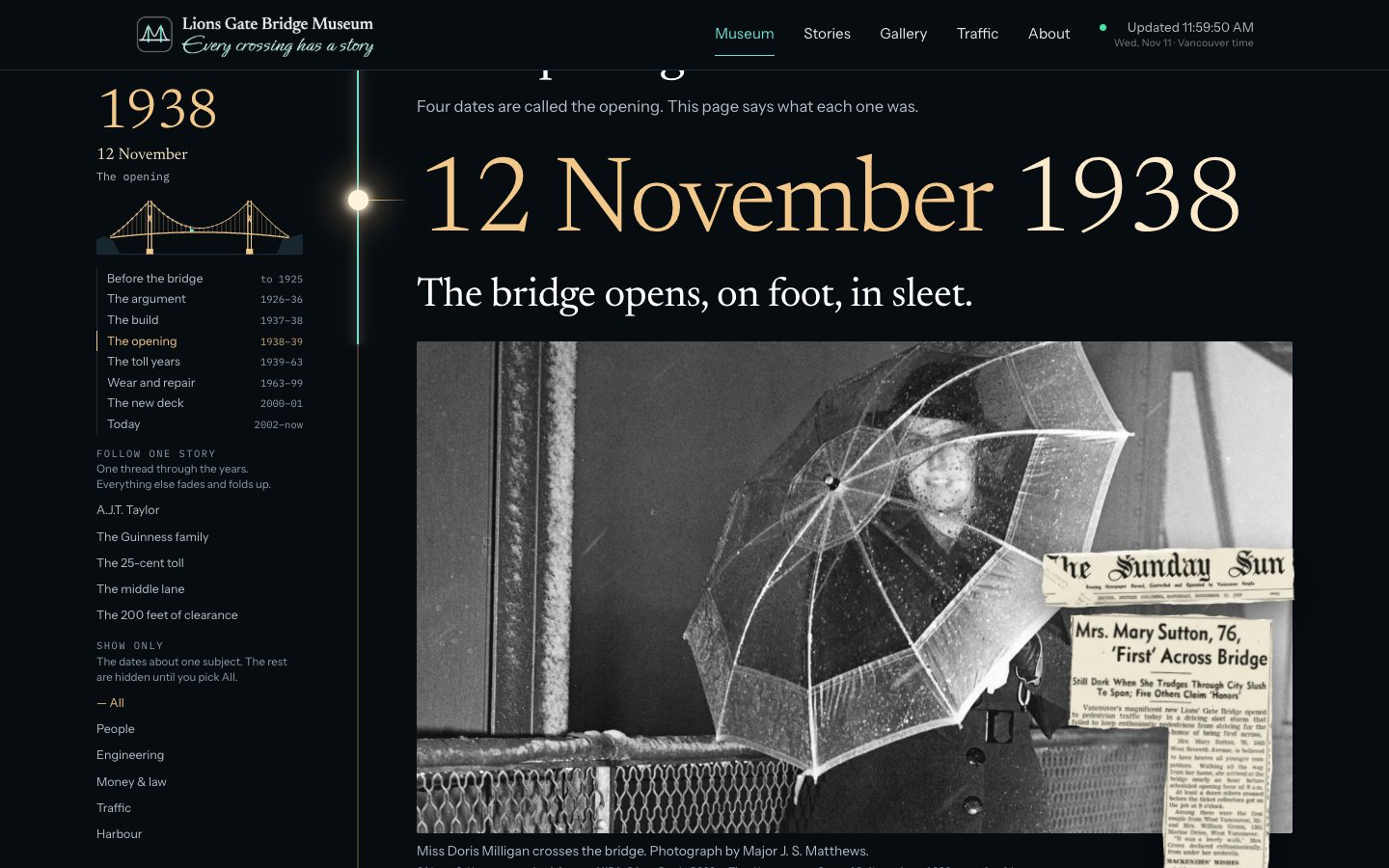
The Lions Gate Bridge Museum gathers that story in one place, so that it is kept and anyone can check it: 201 entries in date order, from the rock of Prospect Point to the lane that changes direction today, each with its source. Seven illustrated stories answer the questions people ask most, such as who was first across, who paid for the bridge and what it cost to cross. The museum also lists five corrections from the primary record, among them that the King and Queen did not open the bridge. It invites people to share their own stories, photographs and objects of the bridge at hello@lionsgatebridge.org.
Thirty changes of direction a day, switched by hand
The Lions Gate Bridge carried an average of 56,582 vehicles a day in 2025 on three lanes. The centre lane changes direction, so that two lanes run one way and one the other. Operators at the Transportation Management Centre of BC switch it by hand.
Since February 2026, the museum has saved the bridge’s lane signals every few minutes. Across 206 complete days from 18 February to 22 October, the centre lane changed direction 29.9 times a day on average. A stretch in one direction usually lasts about 12 minutes. In the museum’s records, southbound delays are longest on Saturdays at 5 p.m.: 30 minutes on average, by the roadside sign. Vancouver as a whole was Canada’s most congested city in 2025, according to the TomTom Traffic Index.
On its home page and at lionsgatebridge.org/traffic, the museum shows current delays in both directions, which way the centre lane is running, when it is expected to switch next and the likely delay over the next three hours. Its machine-learning forecasts are scored in public. A digital twin of the bridge, driven by the same data, is being built.
Ten things you may not know about the Lions Gate Bridge
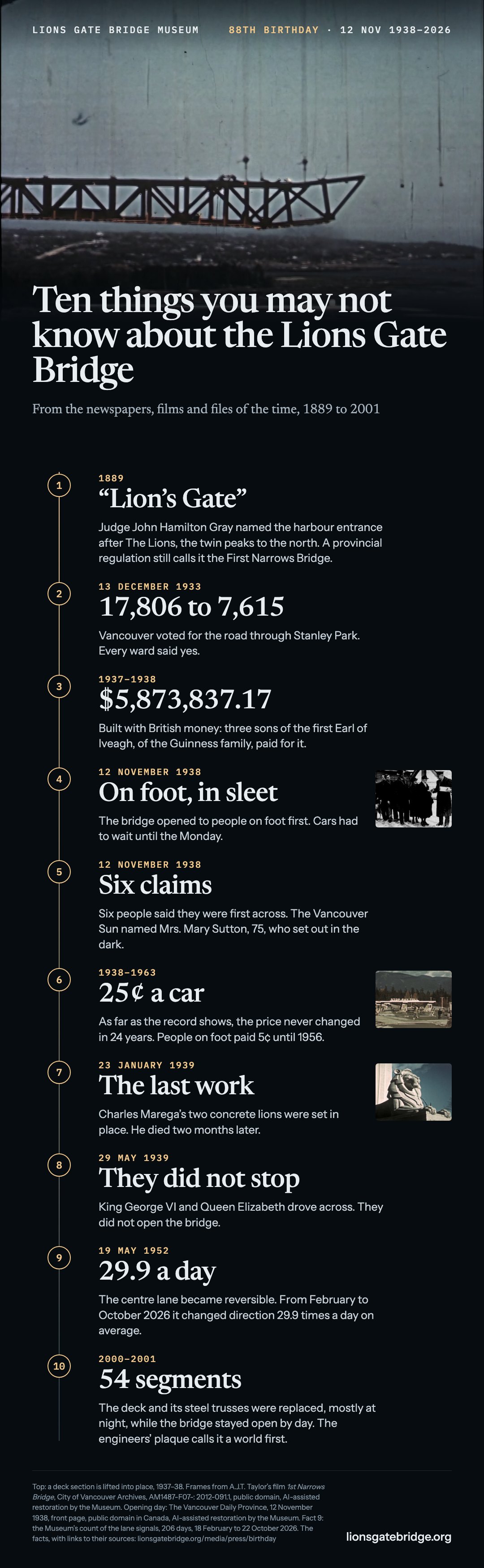
Read the ten facts as text
- 1889 Judge John Hamilton Gray suggested calling First Narrows “Lion’s Gate”, after The Lions, the twin peaks to the north. The bridge took that name. A provincial regulation still lists it as the First Narrows Bridge.
- 13 December 1933 Vancouver voters approved the road through Stanley Park, by 17,806 votes to 7,615. Every ward voted yes.
- 1937–1938 It was built with British money. Three sons of the first Earl of Iveagh, of the Guinness family, financed it through British Pacific Properties. It cost $5,873,837.17.
- 12 November 1938 It opened to people on foot, in sleet. Cars followed on the Monday.
- 12 November 1938 No one can be sure who crossed first. The Vancouver Sun named Mrs. Mary Sutton, 75, who set out in the dark, and reported that five others claimed it too.
- 1938–1963 A car and driver paid 25 cents, and as far as the record shows, the price never changed. People on foot paid 5 cents until 1 August 1956. Tolls ended at one minute past midnight on 1 April 1963.
- 23 January 1939 Its two concrete lions, by the sculptor Charles Marega, were set in place. Marega died two months later, on 24 March 1939; they were his last work.
- 29 May 1939 The King and Queen did not open it. They drove across and did not stop.
- 19 May 1952 The centre lane became reversible, with signs and police directing the traffic. Traffic signals took over in 1965. From February to October 2026 it changed direction 29.9 times a day on average.
- 2000–2001 The deck and its steel trusses were replaced in 54 segments, mostly at night, while the bridge stayed open by day. The Canadian Society for Civil Engineering’s plaque calls it a world first.
Media assets
Photographs, film frames, the infographic and the video, with credits: lionsgatebridge.org/media/press
About the Lions Gate Bridge Museum
The Lions Gate Bridge Museum (lionsgatebridge.org) is an independent digital museum of Vancouver’s Lions Gate Bridge, which opened in 1938. It covers the bridge’s history, engineering and daily traffic, with cited sources and no advertising. It is a project of the Lions Gate Bridge Heritage Society, a BC society incorporated under the Societies Act, and is not affiliated with the Province of British Columbia, DriveBC or Parks Canada.
-30-
Media contact
Lions Gate Bridge Museum
press@lionsgatebridge.org