
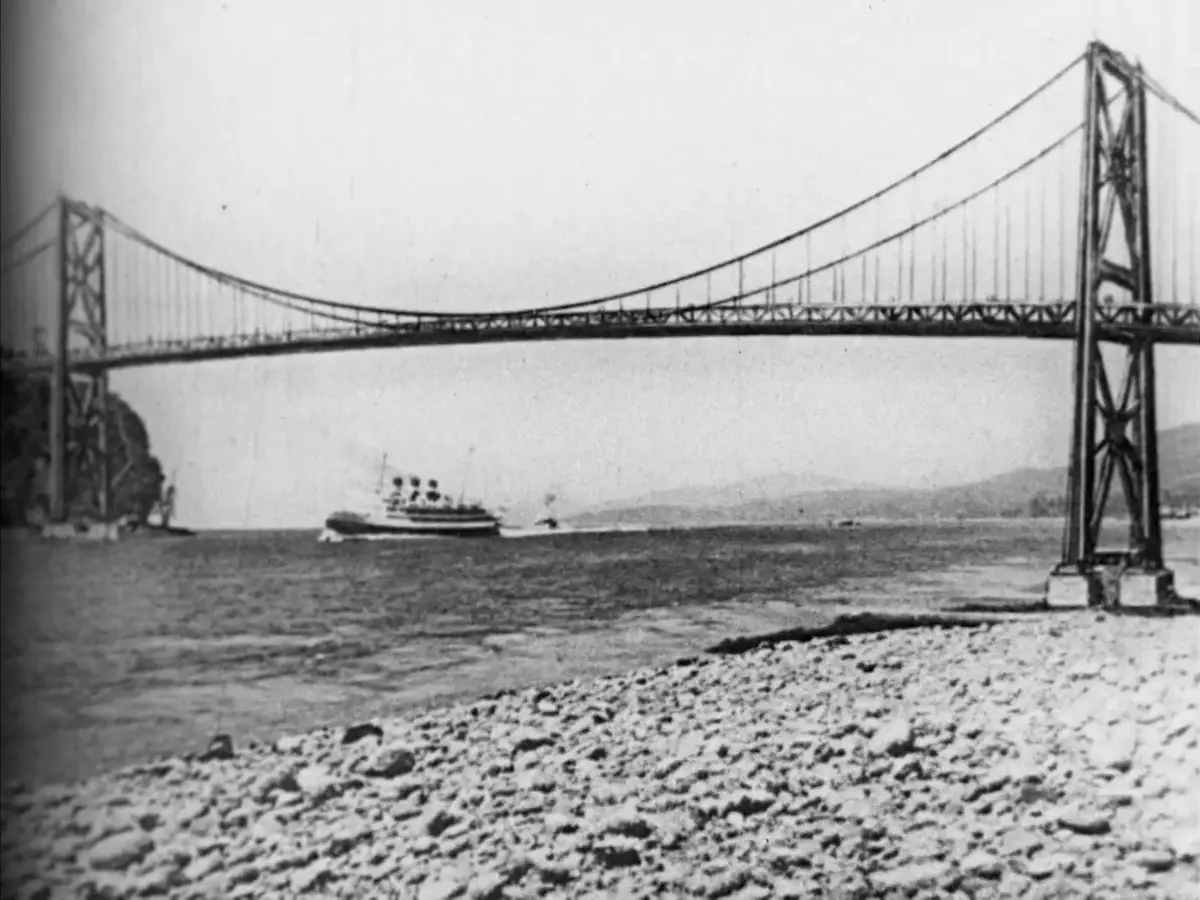
On Thursday 6 September 1934, The Vancouver Sun put the bridge on its front page, and the news was bad. Word from the federal cabinet was that the main span must grow from 1,500 feet to 1,800. The bridge company, the Sun reported, “has been given no official notification”.
The Lions Gate Bridge took shape between 1924 and 1936, in four places at once. West Vancouver offered land. A.J.T. Taylor brought British money. Vancouver voted to let a road run through Stanley Park. And Ottawa, after a long fight over ships, approved the bridge on 30 April 1936.
When did people first talk about a bridge at First Narrows?
Long before anyone could pay for one. The bridge company’s own booklet of 1939 traces the idea to 1890, to a prediction by George Grant Mackay. In 1894 a company won a federal charter for a tunnel under the narrows. In 1909 an engineer, Fred L. Tytler, drew a suspension bridge for people on foot.
None of it was built. A slump in 1913 and the war that followed left the North Shore quiet, the 1999 book Lions Gate says.
The idea came back in 1924. West Vancouver’s reeve, David Morgan, had admired the Clifton Suspension Bridge in England. That year The Province printed a drawing of a bridge at First Narrows, with two 250-foot towers and an 1,800-foot span. The company’s booklet also dates the plan to 1924.
Who were the first bridge companies?
There were two, and they were rivals. The booklet says both were “promoted by Vancouver men”: the First Narrows Bridge Company and the Lions Gate Bridge Company. West Vancouver offered tax breaks to any private builder.
The idea passed its first technical test. A royal commission reported on 15 January 1927 that a bridge was possible. It suggested a 1,400-foot span with 190 feet of clearance for ships.
It failed its first public test. On Saturday 25 June 1927 Vancouver voters turned down the road through Stanley Park that any bridge would need, 4,724 votes to 2,099. Not one of the city’s eight wards voted yes. On 17 June 1930 the two rival companies merged as the First Narrows Bridge Company Limited, with the bridge builder W. C. Ditmars as president.
How did A.J.T. Taylor bring in British money?
Through friends in London. Taylor was an engineering contractor born in Victoria in 1887. In 1926 he moved to England to look for capital and met a retired banker, William Stephen Eyre. In 1928 the two set up British Pacific Securities.
Lord Southborough then brought in three brothers of the Guinness brewing family. West Vancouver had already promised more than 4,000 acres of mountainside to the project. By the early 1930s Taylor’s group controlled the bridge company. The 1999 book Lions Gate says December 1930; the company’s booklet says 1932.
(How the Guinness money worked is a story of its own: Who paid for the Lions Gate Bridge?)
Why did Vancouver have to vote on Stanley Park?
Because the road to the bridge had to cross the park, and the park was precious. Before the Depression, opponents said a bridge would harm Stanley Park, spoil the harbour view and squeeze the shipping channel. Some feared it could be bombed in a war.
The park was not even Vancouver’s to give. It was federal land, a former military reserve. Ottawa had leased it to the city in 1908 for 99 years, at $1 a year. So in August 1932 a federal order set aside up to 4.5 acres, “immediately eastward of the light-house at Prospect Point”, for a bridge head. It still needed the city’s written consent.
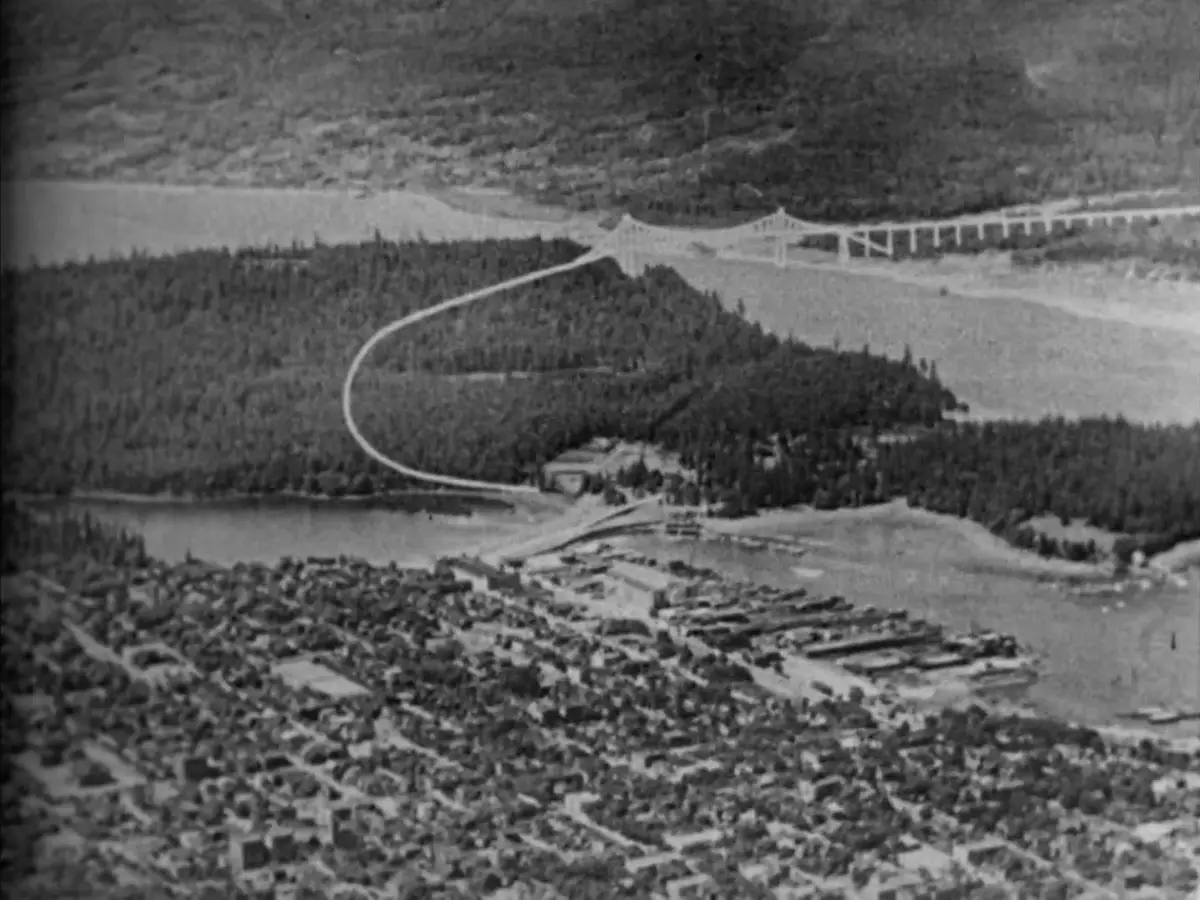
The city’s experts split. On 11 December 1933, Vancouver’s Town Planning Commission voted 5 to 4 against the bridge. It called the plan premature and the design inadequate.
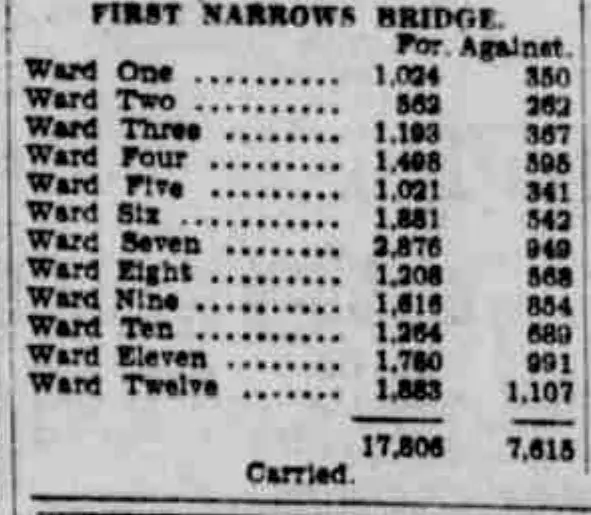
Two days later the voters overruled them. Times were hard, and the bridge was sold as work for the unemployed. On 13 December 1933 the bridge agreement carried, 17,806 votes to 7,615, about 70 per cent. All twelve wards voted yes. Six years earlier, about seven in ten had voted no. The Province had argued against the deal, though not against a bridge. Its editorial the next day said: “The hope of work in connection with the bridge was, no doubt, the overwhelming influence.”
The city’s agreement with the bridge company, which was to take effect only if the voters approved the bylaw, also barred Asian workers from the job. The Province printed the agreement on 1 December 1933, twelve days before the vote. Clause 11 says that “no Asiatic person shall be employed in or upon any part of the undertaking”. The National Post quoted the clause in 2014. Clauses like this were not rare: a provincial review in 2017 found the same ban in Vancouver agreements of 1911 and 1913. In its apology of 2018, the City of Vancouver says it once used its contracts to keep people of Chinese heritage from working for anyone doing business with the city. In the same years, the federal Chinese Immigration Act of 1923 shut out almost all Chinese immigrants, until its repeal in 1947.
We include the clause because it is part of the record.
Why did Ottawa take until 1936?
Because the bridge would cross a harbour, and the shipping interests objected. Under the Navigable Waters Protection Act, Ottawa had the last word.
On Tuesday 17 July 1934, at 11 a.m., the Minister of Public Works held a public hearing in the Hunter Building in Ottawa. The Canadian Pacific Railway objected, with the Vancouver Merchants Exchange, the Chamber of Shipping, the Shipping Federation of British Columbia and a Vancouver alderman. The company had asked for a 1,500-foot span. The protesters wanted 1,800 feet.
That was the fight behind the September headline. The Sun reported that the minister, H. A. Stewart, was acting on Prime Minister R. B. Bennett’s instructions. A Sun headline of the time, reproduced in the book Lions Gate, called it “Bennett’s private blockade”.
Then Taylor lost his partner. W. S. Eyre died in August 1935. Taylor, the book says, decided to wait for the next federal election.
In October 1935 the voters returned Mackenzie King as prime minister. On 30 April 1936, an order in council approved the design and the site. The main piers had to move north, and the main span grew to 1,550 feet between the towers. Work had to start within a year and finish within four. In the company’s booklet, its chairman, Lord Southborough, credits the “good offices” of the prime minister of the day.
What happened after the approval?
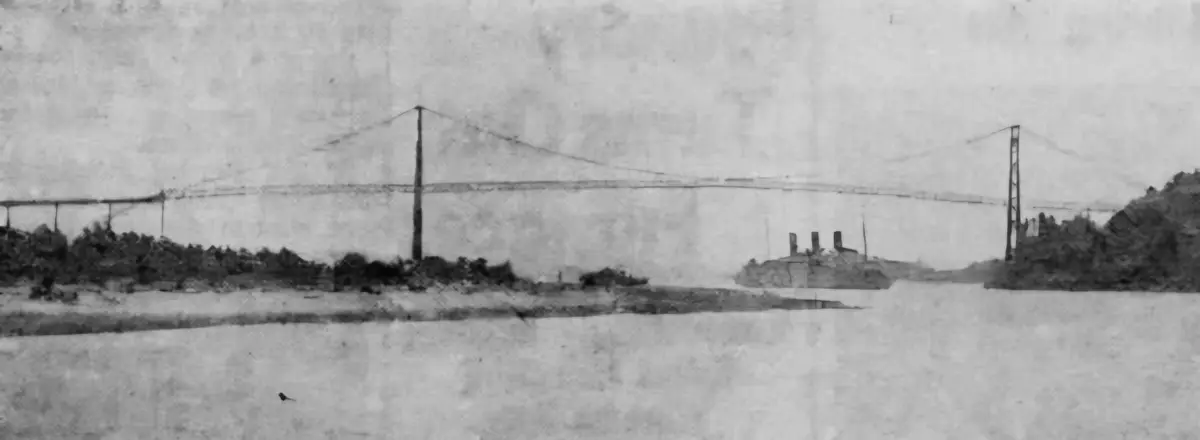
Vancouver celebrated. On 31 May 1936, during the city’s Golden Jubilee, The Province printed a drawing of the coming bridge by Ron Jackson. Its towers looked quite different from the ones built. West Vancouver Archives holds the menu of a citizens’ banquet that August, for the Jubilee and the bridge approval together.
The company let its first contracts in January 1937: on the 21st, by its own booklet, or the 20th, by The Vancouver Sun. On 31 March 1937, crews began clearing the road through Stanley Park.
The old name never quite left. In British Columbia law, the bridge is still the First Narrows Bridge.
If someone asks you: The Lions Gate Bridge was approved in stages: Vancouver voters let a road cross Stanley Park on 13 December 1933, and Ottawa approved the design and site on 30 April 1936. A.J.T. Taylor raised the money from British investors, including the Guinness family.
A city vote, British money and an order from Ottawa. Then the clearing crews went into Stanley Park.
Questions people ask
When was the Lions Gate Bridge approved?
Vancouver voters approved the road through Stanley Park on 13 December 1933, by 17,806 votes to 7,615, about 70 per cent. The federal government approved the bridge’s design and site by order in council on 30 April 1936.
Who came up with the idea of the Lions Gate Bridge?
The idea of a bridge at First Narrows goes back at least to 1890. The project that was built was driven by A.J.T. Taylor, an engineering contractor from Victoria, who raised the money from British investors.
Why was the Lions Gate Bridge controversial?
The road to it had to cross Stanley Park, and shipping interests, including the Canadian Pacific Railway, feared a bridge would limit ships in the harbour. Vancouver voters rejected the park road in 1927, 4,724 to 2,099, and approved the bridge agreement in 1933, 17,806 to 7,615.
Why did Ottawa have to approve the bridge?
The bridge crossed a navigable harbour, which needed federal approval, and Stanley Park was federal land leased to the city. Ottawa held a public hearing on 17 July 1934 and approved the bridge on 30 April 1936.
What is the official name of the Lions Gate Bridge?
In British Columbia law it is still the First Narrows Bridge, the name in the province’s Provincial Public Undertakings Regulation. The company that built it was the First Narrows Bridge Company Limited.
Why is it called the Lions Gate Bridge?
After the harbour entrance it crosses. In 1889 Judge John Hamilton Gray suggested calling First Narrows “Lion’s Gate”, after The Lions, the twin peaks on the mountains to the north. The bridge took that name; the channel kept its own. More in What was First Narrows like before the bridge?
Notes and sources
Show
What we read from the time
- The Vancouver Sun, 27 August 1938, page 26, “Lions Gate Bridge, as West Vancouver Sees it”: the Empress of Japan under the nearly finished bridge, photographed by Andrew Carmichael.
- The Vancouver Sun, 6 September 1934, front page, “Ottawa Ignores First Narrows Builders”, and the editorial on the same page: the 1,800-foot demand, the minister acting on Bennett’s instructions, “no official notification”. We read this Sun page. We quote short lines and do not reproduce the pages.
- Lions Gate Bridge, Vancouver, Canada, a booklet of 1939, on the Internet Archive (archive.org/details/LionsGateBridge): page 4, Lord Southborough’s foreword and the “good offices” of the prime minister; page 6, the 1890 prediction; page 8, the 1924 start, the two companies, the 1927 vote, the 1930 merger, the 1932 date for Taylor’s group, approval on 30 April 1936 and the steel contracts of 21 January 1937; pages 6 and 12, the 1,550-foot span.
- Library and Archives Canada, RG10, volume 7745, file 23167-4 (microfilm C-12041), a federal file on the bridge’s right of way. In it: the notice of the public hearing of 17 July 1934; a memo on who objected; an engineer’s memo of 2 August 1934 on the 1,500-foot application and the 1,800-foot demand; a copy of order in council P.C. 1846 of 22 August 1932, on the bridge head in Stanley Park, which recites the 1908 lease; and the order in council of 30 April 1936 (P.C. 21) with its conditions. We read the microfilm images and our own transcription.
- The Province, 1 December 1933, page 29, “Re First Narrows Bridge Agreement”: the agreement between the city and the bridge company, printed in full; clause 11 on workmen (“Asiatics prohibited”) and clause 22, that it takes effect only when the bylaw authorizing it is approved by the electors. We read this Province page. We quote short lines and do not reproduce the pages.
- The Vancouver Daily Province, 27 June 1927, front page: the results of Saturday’s vote, “Stanley Park road: For, 2099; against, 4724. (Lost).” Page 7: the returns by ward, all eight against. We read this Province page.
- The Vancouver Sun, 20 March 1937, front page, “Start at Once On Bridge”: the city’s final consent, contracts “awarded on January 20”, work to start within two weeks. We read this Sun page.
- The Province, 14 December 1933, page 2: the returns by ward for the First Narrows Bridge, 17,806 for and 7,615 against, “Carried”, with every ward in favour. The Vancouver Sun of the same day printed the same figures on its front page, in “Election at a Glance”. Page 6 of The Province, the editorial “The Bridge Plebiscite”: the paper had opposed the agreement but not a bridge, the vote was “more than two to one”, and “the hope of work”. We read these pages. We quote short lines and show only the table of returns.
- A.J.T. Taylor’s films, City of Vancouver Archives: a black-and-white promotional reel, AM1487-F07-: 2017-055.5, public domain, that opens with the card “Proposed new bridge over First Narrows”. We can date it only to about 1933–35. Our pictures come from about 1 minute 48 seconds and 2 minutes 18 seconds into it.
Later accounts we used
- Lilia D’Acres and Donald Luxton, Lions Gate (Talonbooks, 1999): page 17, Tytler’s 1909 drawing; page 18, the 1894 tunnel charter; page 33, the arguments against and the 1924 Province drawing; page 34, the royal commission; pages 36–37, the merger, Ditmars and the 4,000 acres; page 44, the province and the Park Board in 1933; page 46, the Town Planning Commission vote; pages 52–53, Eyre’s death, the wait for an election and the “private blockade” headline.
- Daniel Francis, Where Mountains Meet the Sea (Harbour, 2016), page 41, and Doreen Armitage, Burrard Inlet: A History (Harbour, 2001): the 1933 vote at about 70 per cent.
- Daniel Francis, “Park in progress”, Geist: West Vancouver’s tax offer and the bridge as a Depression make-work project.
- Tristan Hopper, “B.C. property titles bear reminders of a time when race-based covenants kept neighbourhoods white”, National Post, 16 May 2014: the same clause, as the paper quotes it.
- Province of British Columbia, Chinese Legacy BC: Legislation Review Report (2017), Appendix 1: the 1911 False Creek agreement and the 1913 agreement between the City of Vancouver and the Canadian Northern Pacific Railway, both barring “Asiatic” workers.
- City of Vancouver, official apology for historical discrimination against people of Chinese descent, 22 April 2018 (text): the city’s contracts and grants.
- Arlene Chan, “Chinese Immigration Act”, The Canadian Encyclopedia: the act of 1 July 1923 and its repeal in 1947.
- MONOVA, “Building a Vancouver Icon”: Taylor finally won Mackenzie King’s support.
- Encyclopedia of British Columbia, “Taylor, Alfred James Towle”, and North Shore Heritage Preservation Society, “Taylor Made” (2024): Taylor, Eyre, British Pacific Securities and Southborough.
- The Province’s Golden Jubilee drawing by Ron Jackson, 31 May 1936, as listed in our sources; West Vancouver Archives, Joseph B. Leyland fonds, “Lions Gate Bridge ephemera”: the banquet menu of 12 August 1936. We read the catalogue entry, not the menu.
- Province of British Columbia, Provincial Public Undertakings Regulation (B.C. Reg. 513/2004): the name First Narrows Bridge.
- BC Geographical Names, “First Narrows”: Judge Gray’s “Lion’s Gate”, 1889, after The Lions.
Our readings
- That the September 1934 front page and the July hearing were one fight is our reading of the two documents together.
- We give the 1933 clause from the agreement as The Province printed it; the National Post quotes the same words. We have not read the bylaw itself.
- The order of 30 April 1936 was amended on 9 September 1936, which changed how far the piers moved. We give only the final span.
Spotted a mistake? Tell us at [email protected]. We correct the page and note the date.