
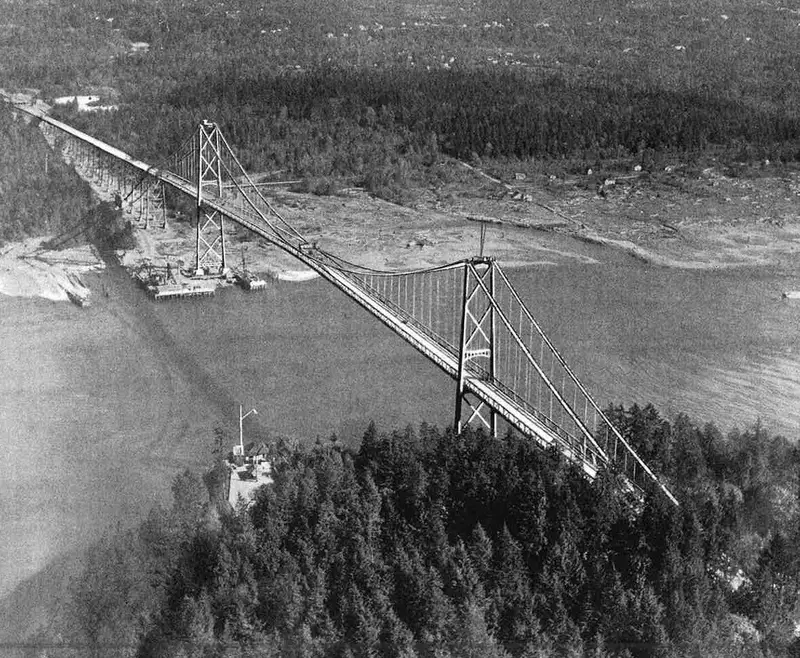
On 22 March 1939, a four-masted yacht sailed into Vancouver harbour. She was the Fantome, 1,223 tons, out from England by way of the West Indies and San Francisco. The Vancouver Sun said her owner had come to look at the new Lions Gate Bridge and the North Shore project, both “financed by the British syndicate which he heads”. Her owner was the Hon. A. E. Guinness.
The Lions Gate Bridge was paid for privately, by British investors led by three brothers of the Guinness brewing family. The money ran through two companies: British Pacific Properties, which owned 4,000 acres of West Vancouver, and the First Narrows Bridge Company, which built and ran the bridge. The bridge was the road to the land.
Who were the Guinnesses behind the bridge?
Three brothers, the sons of the first Earl of Iveagh. Rupert Guinness was the second Earl of Iveagh. Walter Guinness was the first Baron Moyne. The third was Arthur Ernest Guinness, the yacht owner of 1939.
They came in through Lord Southborough. He was a London contact of A.J.T. Taylor, the Victoria-born engineer who had gone to England in 1926 to find money for the bridge. Southborough introduced Taylor’s plans to the brothers, and they put up most of the money.
Some of the family came to see it. In June 1934, a party travelled to Vancouver in a private railway car: Taylor, Southborough, the banker W. S. Eyre, two younger Guinnesses and a trustee of the Iveagh Trust.
Why would a brewing family build a bridge in Vancouver?
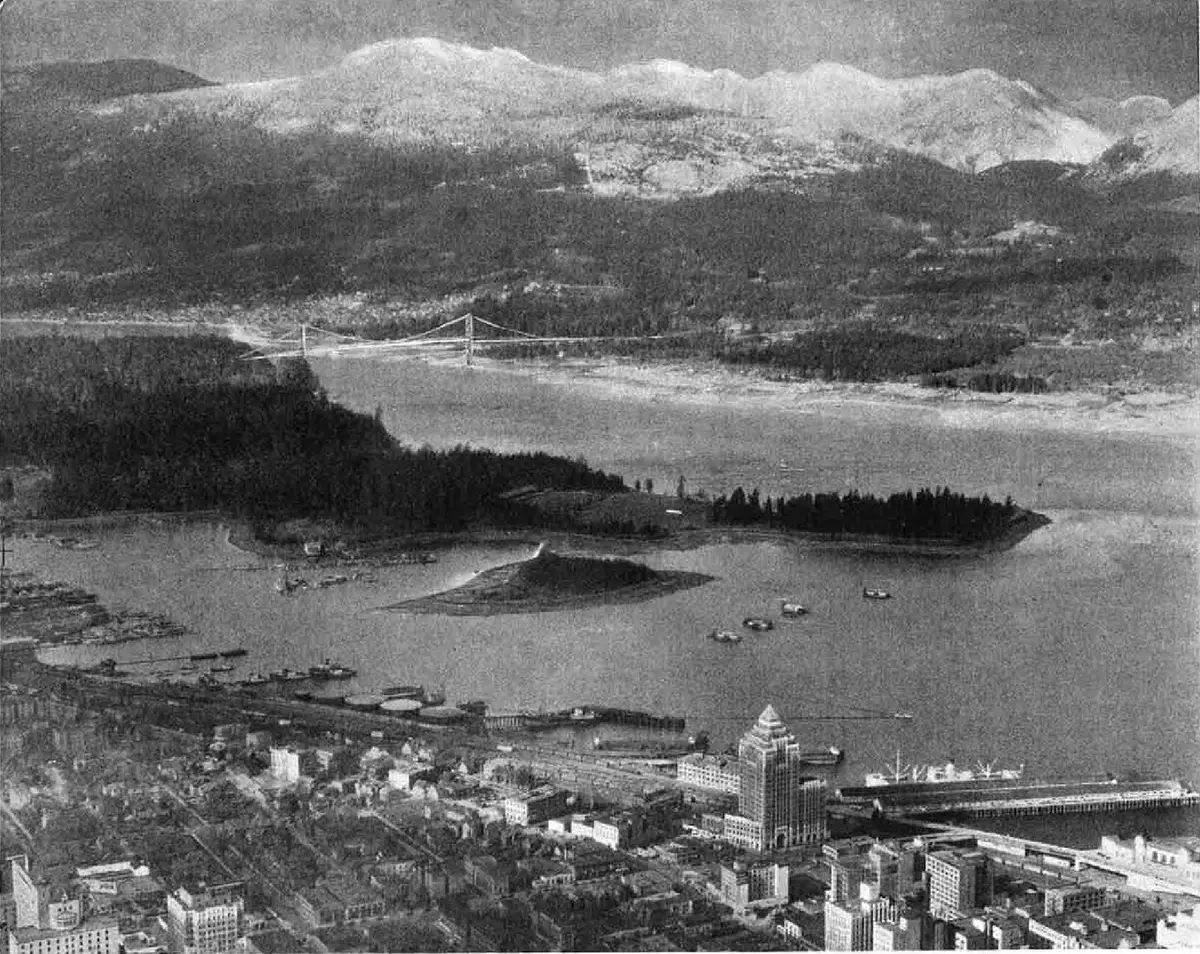
For the land. On 18 November 1931, British Pacific Properties bought 4,000 acres of mountainside from the District of West Vancouver. It paid $75,000 and promised to spend $1 million on improvements within five years.
West Vancouver had the land cheap. Earlier speculators had walked away from it and left the taxes unpaid. The 1999 book Lions Gate ties its development to the bridge.
In 1933 the Boston firm Olmsted Brothers laid out the first 1,000 acres. A golf course opened in 1937. In February 1938, Taylor told a Board of Trade group that the company had spent $1.5 million to $2 million on Capilano Estates since 1932.
The estates also came with rules about who could live there. The 1999 book Lions Gate records covenants on British Properties land that kept out Asian residents. In 2014 the National Post found one current title that still bars a sale to “any person or persons of African or Asiatic race or of African or Asiatic descent”. Under British Columbia’s Land Title Act such covenants are void, and an owner can ask the land title registrar to cancel one at no charge.
The company’s 1939 booklet was open about the tie between the estates and the bridge. It calls them “twin achievements”, developed by the same interests that “provided the capital for the Lions Gate Bridge”.
On the day of the 1933 vote, one of the bridge’s engineers, P. L. Pratley, put it plainly: the bridge was “part of a larger project”, and “our clients here have never worried if the bridge could be made to pay”, The Province reported.
How was the money raised?
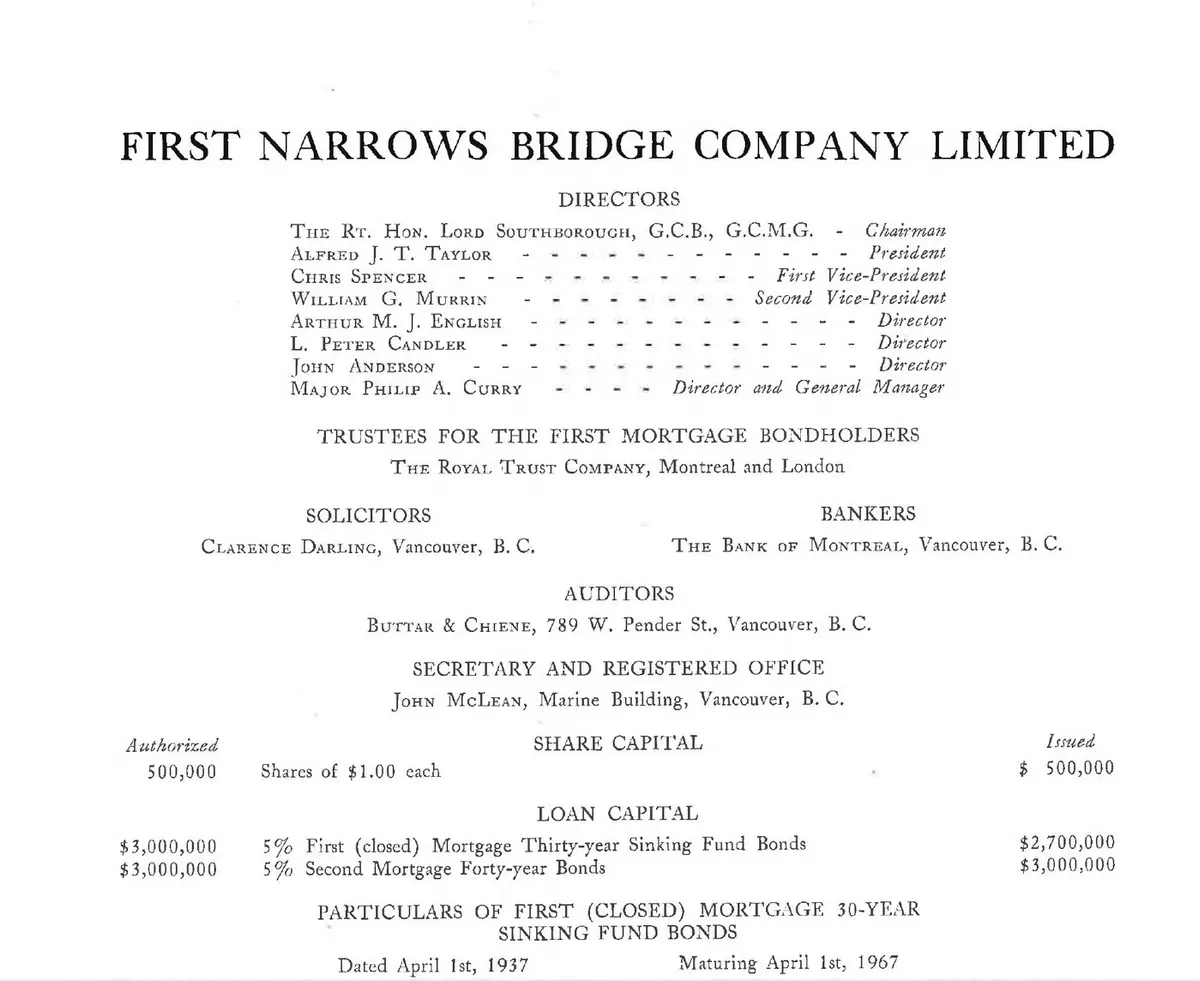
Mostly as bonds. Page 47 of the 1939 booklet lays out the First Narrows Bridge Company’s finances.
The company could issue 500,000 shares at $1 each. It also issued $2.7 million of first-mortgage bonds at 5 per cent, due in 1967. On top of that came $3 million of second-mortgage bonds, also at 5 per cent, over 40 years.
Add the two bond issues and you get $5.7 million. That is exactly the cost the same booklet gives for the whole project, with its approaches, the park road, the franchise and working capital. Our reading is that the bridge was built almost entirely on borrowed money.
Who lent it? Largely the owners themselves, it seems. In April 1938 the Sun reported that the Guinness interests held over 80 per cent of British Pacific Properties, with a matching share of its bonds. In the bridge company, it said, they had a “similar interest”. Their man in Canada, L. Peter Candler, sat on both boards. On the bridge company’s, the Sun said, he represented the majority of the shares, which the Guinness interests held.
How much each brother paid, we do not know. No source we have read splits the money among them.
How much did the Lions Gate Bridge cost?
About $5.7 million to $6 million, depending on the source. The company’s booklet gives $5,700,000 for the project. The Canadian Encyclopedia gives $5,873,837.17. As work was about to begin, in March 1937, the Sun called it “the $6,000,000 First Narrows Bridge”. In March 1939 The Province put the cost at $5,800,000.
The $6,000,000 was an estimate. We have not seen accounts that reconcile the other two.
Did the bridge make money?
Slowly. In May 1939 the Sun reported tolls of about $20,000 a month. By 1953 the company still owed $3,713,500 on its bonds, against assets of $5,079,438. It expected to be clear of debt before 1977.
By then the bridge was crowded, and the company wanted to build a twin beside it. To pay for a second span, it wanted higher tolls. In January 1955, Premier W. A. C. Bennett refused to change the 1927 act that capped them.
Why did the Guinness family sell the bridge?
Because the province wanted it, and the company could not grow it on the old tolls. On 18 January 1955 the cabinet authorized the province’s toll authority to buy the company’s shares. The Vancouver Sun gave the price on its front page on 21 January 1955: $5,959,060. The sale had been completed the day before. Bennett called it $6,000,000.
The Guinness side said it was “self-evident” that the government should own and control the bridge and its planned twin. In the legislature, an opposition member said the province had been “taken down the river”, paying $6,000,000 for a bridge that cost $5,700,000. A reader wrote to the Sun that the province got it at half price.
Some later accounts say the family sold at the original cost of $5,873,837. That figure is the cost of building, not the price of the sale.
What did the Guinnesses leave behind?
A neighbourhood, and the lights. In 1956 the branches of the family divided their holdings in British Pacific Properties. In 1986 the family paid for the lights along the main cables, for Vancouver’s centenary and Expo 86. The two strands of lights cost $300,000, The Province reported. On 19 February 1986, Premier Bill Bennett gave the signal to switch them on from the ferry Queen of Tsawwassen. Louise and Erskine Guinness cut a cake to mark the night. A Sun editorial that week said the family “underwrote the cost”. It gave most of the credit to the provincial secretary, Grace McCarthy, “whose brainchild it was”, and proposed a name: “Gracie’s Necklace”.
The company that bought the mountainside still develops it. In 2025 it shortened its name to British Properties.
If someone asks you: The Lions Gate Bridge was built with private British money, led by Guinness brothers Rupert, Arthur Ernest and Walter. Their company owned 4,000 acres of West Vancouver; the bridge opened the land. The province bought the bridge company in January 1955.
First the Guinnesses bought a mountainside. Then they built the road to it.
Questions people ask
Did the Guinness family build the Lions Gate Bridge?
They paid for it. Three Guinness brothers, Rupert, Arthur Ernest and Walter, led the British investors behind the First Narrows Bridge Company. The company paid; contractors built it. Dominion Bridge and Hamilton Bridge (Western) did the steelwork, and Stuart Cameron Ltd. built the piers.
Why did the Guinness family build the Lions Gate Bridge?
To open up their land. Their company, British Pacific Properties, bought 4,000 acres of West Vancouver in 1931, and the bridge was the road from the city to it.
How much did the Lions Gate Bridge cost?
The company’s 1939 booklet gives $5,700,000 for the whole project; The Canadian Encyclopedia gives $5,873,837.17. The money was raised mostly as 5 per cent bonds.
When did the Guinness family sell the Lions Gate Bridge?
In January 1955, when the province’s toll authority bought the bridge company’s shares. The Vancouver Sun reported the price as $5,959,060.
Who were the Guinness brothers?
The three sons of the first Earl of Iveagh: Rupert, the second Earl; Walter, the first Baron Moyne; and Arthur Ernest Guinness.
Notes and sources
Show
What we read from the time
- Lions Gate Bridge, Vancouver, Canada, a booklet of 1939, on the Internet Archive (archive.org/details/LionsGateBridge): pages 10–11, the “twin achievements”; pages 18–19, the $5,700,000 and what it covers; page 47, the shares, both bond issues, the trustees and the franchise. That the bond total equals the project cost is our own sum.
- The Vancouver Sun: 20 March 1937, front page, “Start at Once On Bridge” (the $6,000,000 bridge); 5 April 1937, page 15 (the $6,000,000 estimate); 15 February 1938, page 2 (Taylor on Capilano Estates); 8 April 1938, page 30 (the Guinness share and L. Peter Candler); 22 March 1939, page 22 (the Fantome); 26 May 1939 (about $20,000 a month in tolls); 14 January 1955 (the 1953 accounts and Bennett’s refusal); 20 and 21 January 1955 (the share purchase and the Guinness statement); 21 January 1955, front page (the price of $5,959,060 and the sale completed on the Thursday); 22 January 1955, page 2 (Bennett’s $6,000,000); 10 February 1955, page 1 (“taken down the river”); 12 February 1955, page 4 (the reader’s letter); 20 February 1986, page A2 (the ferry, continued from a front page we have not read); 24 February 1986, editorial page, “A string of pearls” (the centenary, the cost, McCarthy and the name). We read these Sun pages. We quote short lines and do not reproduce the pages.
- The Vancouver Daily Province, 28 March 1939, page 10, “Gyros See Bridge Built In Pictures”: the cost given as $5,800,000, with no source named. 27 May 1939, page 21, “High Tribute Paid Builders At Gate Bridge Ceremonies”: Dominion Bridge “joint contractors with Hamilton Bridge (Western) Ltd.”, and William Way of Stuart Cameron, Ltd., who “superintended the construction of piers”. We read these Province pages.
- The Province, 14 December 1933, page 5, “Many Bridges Are Planned”: P. L. Pratley, of the engineers Monsarrat & Pratley, to Vancouver’s Professional Engineers’ Club on 13 December: the bridge “part of a larger project”, and the clients who “never worried” whether it could be made to pay. Read in the same archive.
- The Province, 20 February 1986, page 15: the new lights, the two strands costing $300,000, paid for by the Guinness family. Read in the same archive.
Later accounts we used
- Lilia D’Acres and Donald Luxton, Lions Gate (Talonbooks, 1999): page 31, the tax-default land; page 51, the covenants on British Properties land; page 48, the June 1934 visit (from the Sun of 7 June 1934); page 52, Southborough and the three brothers; page 153, the price of $5,959,060, which the Sun’s front page of 21 January 1955 also gives.
- North Shore Heritage Preservation Society, “Taylor Made” (2024), and North Shore News, special supplement on British Properties, 28 July 1996: the three brothers, the $75,000 and the 1956 division.
- Tristan Hopper, “B.C. property titles bear reminders of a time when race-based covenants kept neighbourhoods white”, National Post, 16 May 2014: the wording on a current British Properties title.
- Land Title and Survey Authority of BC, Practice Note 01-15, “Land Title Act section 222 – Cancellations of discriminating covenants” (2015, updated 2020): such covenants are void, and the registrar cancels them on request or on its own initiative, with no fee.
- British Properties, “Our story”: the purchase of 18 November 1931, Olmsted Brothers, the golf course and the 2025 name. Wikipedia, “British Properties”: the $1 million promise.
- The Canadian Encyclopedia, “Lions Gate Bridge”: $5,873,837.17. Julia Piper, “Historic Places: Lions Gate Bridge”, The Vancouver Sun, 2020, and Wikipedia, “Lions Gate Bridge”: the sale at the original cost, which we read differently.
- The 1986 lights: the Vancouver Heritage Foundation plaque, “Places That Matter #63”, and The Canadian Encyclopedia (the Guinness gift for Expo 86); North Shore News, 21 February 1986 (the signal from the Queen of Tsawwassen, the Guinness cake); the provincial transportation ministry’s report for 1985/86 (19 February 1986).
Our readings
- That the bridge was “the road to the land” is our reading of the booklet’s “twin achievements” and of Pratley’s words in 1933.
- That the owners lent most of the money is our reading of the Sun’s April 1938 report; it gives the Guinness share of British Pacific Properties and its bonds as over 80 per cent, and says the Guinness interests held the majority of the bridge company’s shares.
- That $5,873,837 is the building cost and not the sale price follows from the 1999 book and the Sun’s reports of January 1955.
- That the Sun’s “Hon. A. E. Guinness” is Arthur Ernest, the third brother, is our reading of the initials.
Spotted a mistake? Tell us at [email protected]. We correct the page and note the date.