
In the last week of March 1963, a letter reached The Vancouver Sun from a toll collector on the Lions Gate Bridge. The collector thanked the more than 99 per cent of drivers who had paid with good grace. To the rest, the letter had one line: “after April 1 you won’t be missed”.
From November 1938 to 1 April 1963, a car and its driver paid 25 cents to cross the Lions Gate Bridge. Passengers in private cars and people on foot paid 5 cents each, until the province dropped their toll on 1 August 1956. As far as we can find, the price for a car never changed. Here is how the tolls worked, who kept the money, and why they lasted so long.
How much was the toll on the Lions Gate Bridge?
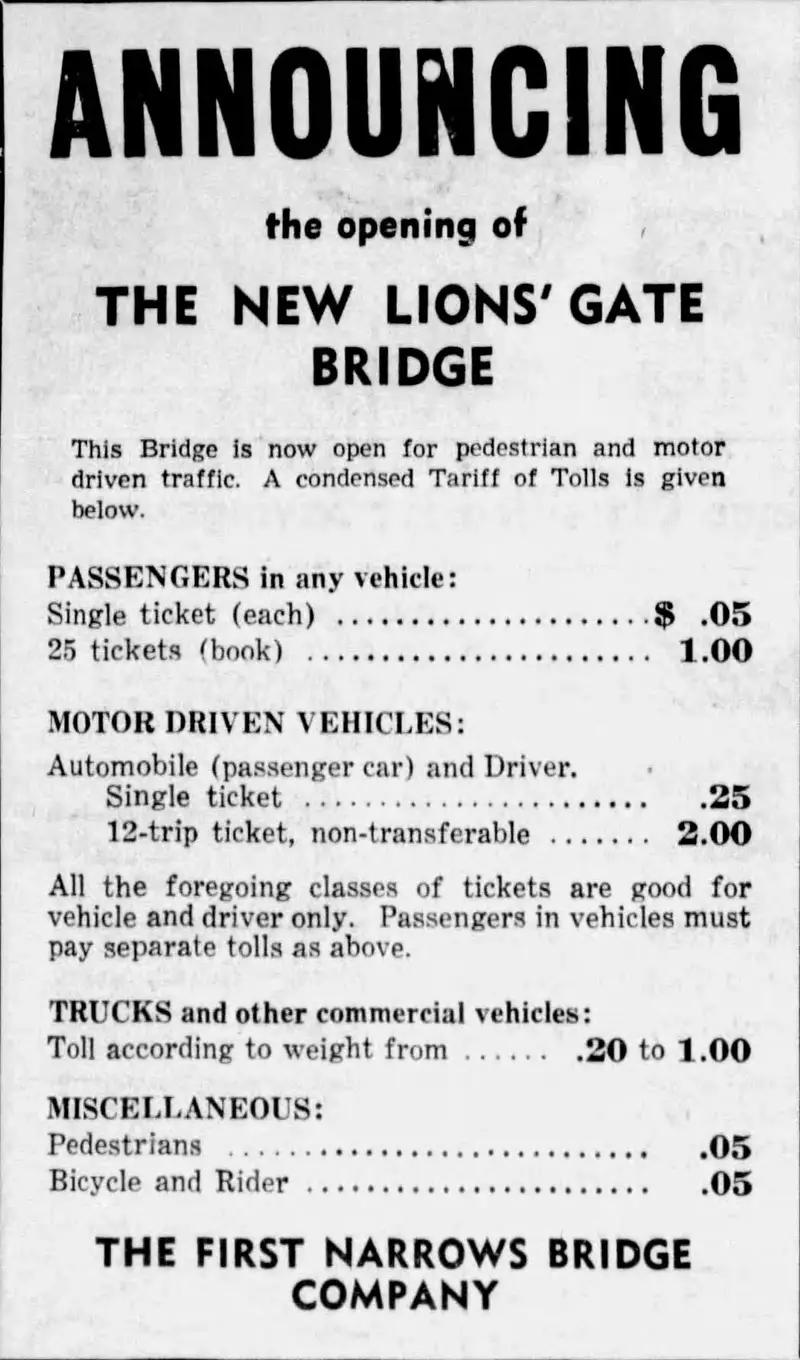
A quarter for a car, a nickel for a person. The company’s general manager, Major P. A. Curry, announced the scale on 29 September 1938. A car and driver paid 25 cents. Each extra passenger paid 5 cents. People on foot paid 5 cents, and so did a cyclist. Children under five crossed free. A driver could buy a weekly pass for $1.25 or a twelve-trip ticket for $2; passengers, a book of 25 tickets for $1.
In today’s money that was not small change. By the consumer price index behind the Bank of Canada’s inflation calculator, 25 cents in 1938 is about $5.51 in September 2026 dollars. The $1.25 weekly pass comes to about $28.
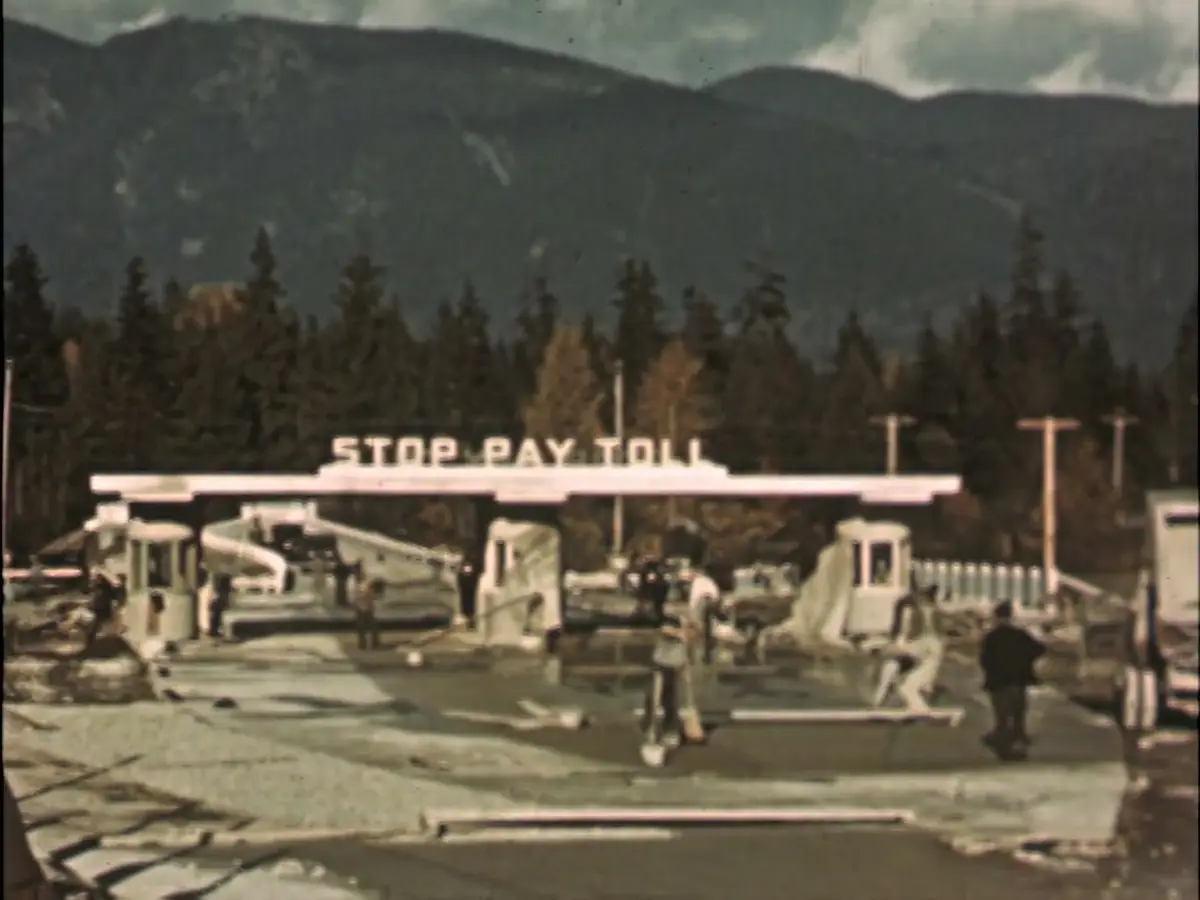
The booths were split by kind. Late in October 1938 the Sun reported two toll houses for cars at the north end, and one for people on foot at the south end.
Walkers paid first. The bridge opened to them on Saturday 12 November 1938, with the collectors due at 9 o’clock. About 1,200 paid the pedestrian toll that Saturday, in sleet, and 5,750 on the Sunday, the company said. Cars and their tolls followed on Monday 14 November. On the afternoon of Sunday 20 November, the Sun reported, twelve collectors were on the bridge.
The company could only estimate the first week: more than 15,000 vehicles and 40,000 people on foot or riding as passengers. “Owing to the large number of weekly tickets and commutation books in circulation,” Major Curry told The Province, “it is impossible to state the exact number of cars and passengers.”
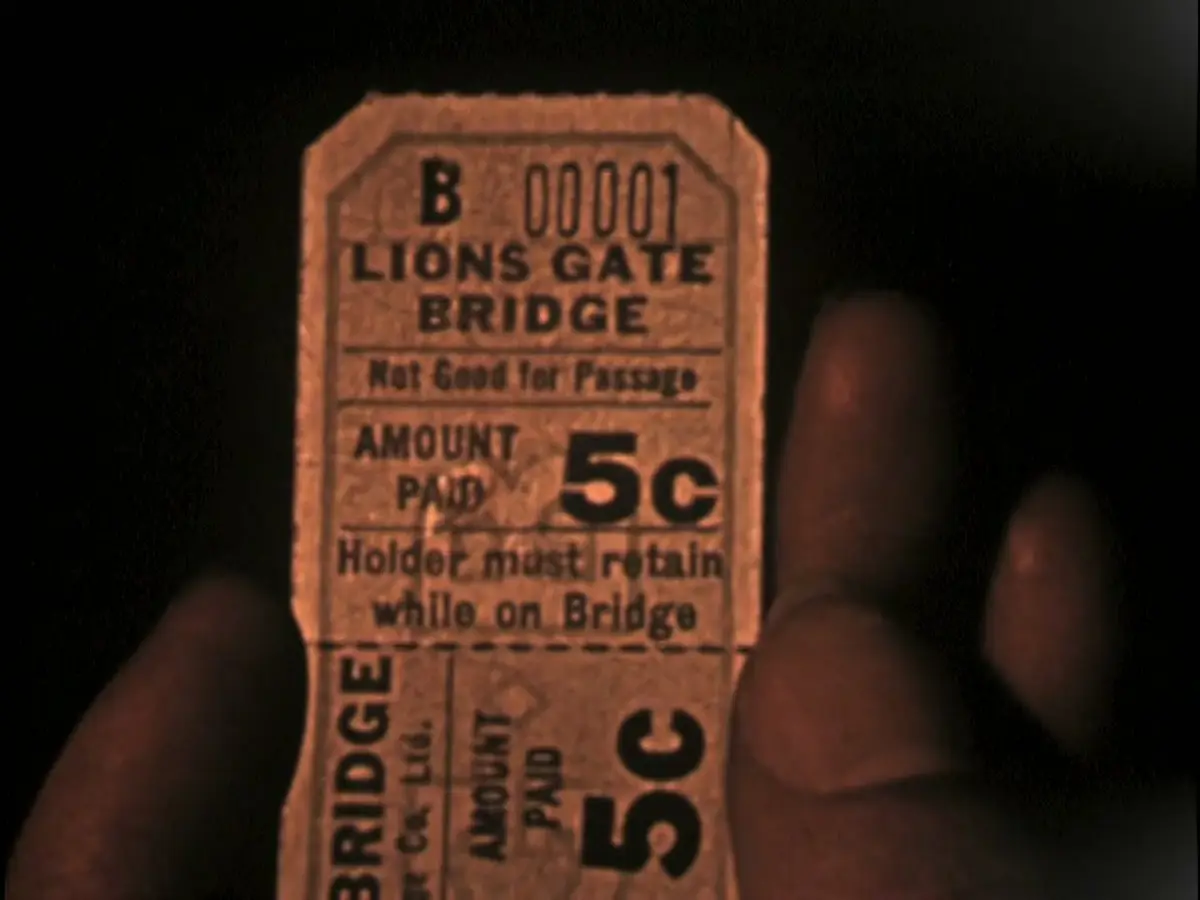
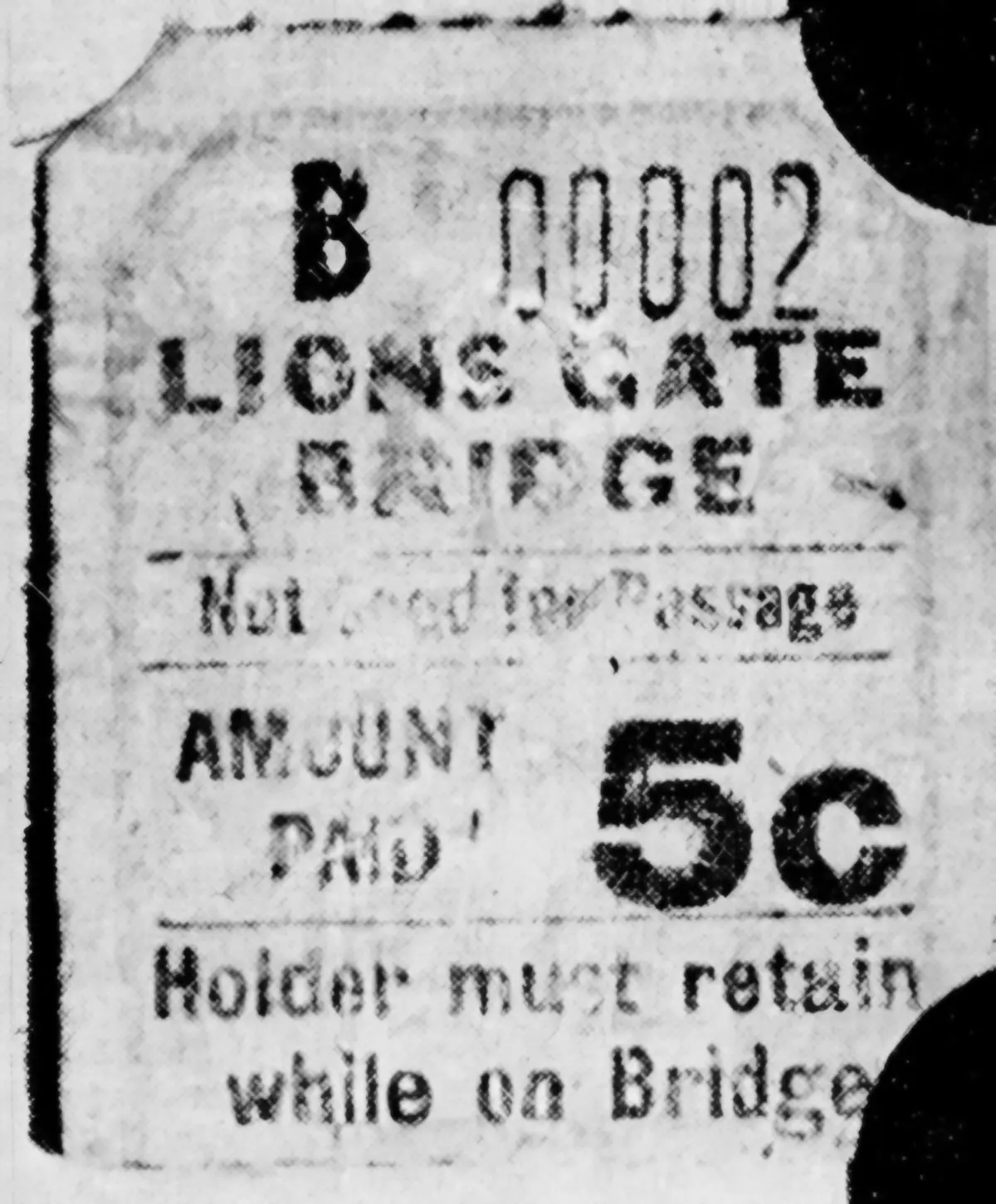
You may see 7½ cents given for people on foot. That was the most the 1927 act allowed, as we explain below. What walkers paid was a nickel: the papers of 1938 and 1939 say so, and A.J.T. Taylor’s construction film shows ticket B 00001 marked “Amount paid 5c”.
Who set the price, and who kept the money?
The law capped it, and the company kept most of it. The bridge company’s act of 1927 allowed it to charge at most 25 cents for a car, 5 cents for each passenger and 7½ cents for a person on foot. The company charged people on foot 5 cents. Vancouver and the two North Shore municipalities gave the company an exclusive franchise for 50 years from November 1938.
There were exceptions. A federal lease of 27 November 1936, for the bridge’s land in Stanley Park, let members of Canada’s armed forces, and federal employees on duty, cross without paying.
The cities got a share. In January 1955, the Sun reported that Vancouver and West Vancouver each received about $35,000 a year from the bridge’s tolls.
How much did the tolls bring in?
About $20,000 a month at first. From 14 to 30 November 1938, 51,137 vehicles and 98,532 passengers and walkers went through the toll booths. By May 1939, the Sun reported, the bridge was taking in “something like $20,000” a month.
The company kept improving the gates. In May 1939 it installed a new toll register. Each payment lit up in neon on an indicator, and so did a weekly pass or a punch card.
The new bridge took business from the old one. In January 1939 a North Vancouver man, A. P. Croker, told the Board of Trade that the Second Narrows Bridge would lose about $25,000 a year to it.
During the war, the toll booths sold Victory Bonds as well as tickets, as a photograph in the City of Vancouver Archives records.
Why didn’t the tolls end when the province bought the bridge?
Because the province wanted its money back. It bought the bridge company in January 1955 for $5,959,060. The 1999 book Lions Gate says the province kept the tolls to recover the cost.
Little changed at the gates at first. In February 1955 a reader complained to the Sun about morning line-ups, with six southbound toll gates open. The weekly ticket still cost $1.25, as it had in 1938.
The first cut came in 1956. On 12 July, Premier W. A. C. Bennett announced that passengers in private cars and people on foot would cross without paying from 1 August. Bus passengers were still under discussion. The Province reported that the bridge had taken in about $1,200,000 in tolls in 1955. The highways minister, Phil Gaglardi, put the passengers’ savings at $400,000 a year or more. A car and driver still paid 25 cents.
When did the tolls end on the Lions Gate Bridge?
At one minute past midnight on Monday 1 April 1963. By then the quarter had shrunk in value. In September 2026 dollars, 25 cents in 1963 is about $2.64, less than half its 1938 worth. That day the Sun reported that the crossing took about half its usual 25 minutes. Traffic cones funnelled five empty toll stations into two lanes, and cars rolled through at about 30 miles an hour. A few drivers still stopped at the booths. Others reached for passes clipped to their sun visors.
Keeping the booths had cost money too. In 1962–63, its last full year of tolls, the province spent $79,701.40 to maintain the toll facilities on the bridge. West Vancouver Archives holds a weekly pass good on both the First Narrows and Second Narrows bridges, dated from 29 March 1963, days before the end.
By the next day, crews had started taking down the toll gates, a two-week job, the Sun said.
So what did the bridge really cost the public?
More than its price. The 1999 book Lions Gate puts it bluntly: by 1963 “the public had now paid for the bridge twice”. Our reading is that this is fair as a figure of speech. The tolls paid the company’s bonds, then paid back the province’s purchase.
Today there is no toll, and there has been none for longer than there was one.
If someone asks you: From 14 November 1938 to 1 April 1963, a car and driver paid 25 cents to cross the Lions Gate Bridge. Passengers in private cars and people on foot paid 5 cents until 1 August 1956, then paid nothing.
As far as we can find, a car and its driver paid 25 cents for all 24 years. The one change came in 1956: passengers and people on foot stopped paying.
Questions people ask
Does the Lions Gate Bridge have a toll?
No. Tolls ended at 12:01 a.m. on 1 April 1963. From November 1938 until then, a car and driver paid 25 cents.
How much was the toll on the Lions Gate Bridge in 1938?
25 cents for a car and driver, 5 cents for each extra passenger and 5 cents for a person on foot. A driver’s weekly pass cost $1.25.
When did the Lions Gate Bridge stop charging tolls?
On 1 April 1963, at one minute past midnight. Passengers in private cars and people on foot had already stopped paying on 1 August 1956.
Who collected the tolls on the Lions Gate Bridge?
The First Narrows Bridge Company collected them from 1938 until January 1955, when the province bought the company. The province then collected them until 1963.
Why did the province keep the tolls after buying the bridge?
To recover what it had paid for the bridge: $5,959,060, The Vancouver Sun reported in January 1955.
Notes and sources
Show
What we read from the time
- The Vancouver Daily Province, 12 November 1938, front page: ticket B 00002, enlarged beside R. F. Hearns.
- The Vancouver Daily Province, 29 September 1938, front page, “First Narrows Span May Open On November 8”: the full scale of tolls, from the 5-cent pedestrian to the $1 bus. 17 November 1938, page 10: the company’s advertisement announcing the opening, with the same tolls. 23 November 1938, page 16, “15,000 Autos, 40,000 People Cross Bridge”: the first week’s estimate and Curry’s words. We read this Province page. We quote short lines and do not reproduce the pages.
- The Daily Colonist (Victoria), 30 September 1938, Canadian Press report: Curry’s scale of tolls. Free to read on the Internet Archive.
- The Vancouver Sun: 27 October 1938, page 3 (the toll houses); 14 November 1938, page 5 (the pedestrian tolls paid on the first Saturday and Sunday); 29 October 1938, page 32 (“the pedestrian toll of 5 cents”); 12 November 1938 (the collectors due at 9); 14 November 1938, front page (the first cars); 22 November 1938, page 2 (the first Sunday, with twelve collectors in the afternoon); 3 December 1938, page 17 (the November totals); 20 January 1939, page 6 (the Second Narrows Bridge); 27 January 1939, page 7 (“the nickel toll”); 17 May 1939, page 5 (the new register); 26 May 1939 (about $20,000 a month); 14 January 1955 (the 1927 act); 21 January 1955, front page (the price) and page 2 (the cities’ shares); 25 February 1955, page 4 (the reader’s letter); 27 March 1963, page 4 (the collector’s letter); 1 April 1963, page 1 (the end of tolls); 2 April 1963, page 2 (the toll gates coming down). We read these Sun pages. We quote short lines and do not reproduce the pages.
- The Province, 1 December 1933, page 29, the agreement between the city and the bridge company, printed in full: it quotes section 6 of “The First Narrows Bridge Company, Limited, Act”, Statutes of British Columbia, 1926–27, chapter 80, on tolls “not to exceed” the sums it lists, among them 7½ cents for pedestrians, 25 cents for automobiles and 5 cents for passengers. We read this page.
- The Province, 12 July 1956, “Lions Gate Tolls To Be Cut”: the end of tolls for passengers and walkers, the 1955 total and the toll scale. We read this page.
- Lions Gate Bridge, Vancouver, Canada, a booklet of 1939, on the Internet Archive (archive.org/details/LionsGateBridge), page 47: the 50-year franchise.
- A.J.T. Taylor, 1st Narrows Bridge, a 16 mm colour film of the construction, 1937–38, City of Vancouver Archives: the toll gate, about 38 minutes 26 seconds into the archives’ master copy, and ticket B 00001, about 39 minutes 43 seconds into it.
- Library and Archives Canada, RG10, volume 7745, file 23167-4 (microfilm C-12041): the lease of 27 November 1936, clause 5.
- Bank of Canada, Inflation Calculator and its data series (total CPI, 2002 = 100): annual averages 1938 = 7.708 and 1963 = 16.125; September 2026 = 170.0.
- Province of British Columbia, Department of Highways, annual report for 1962–63 (UBC Library Open Collections): $79,701.40 for the toll facilities.
Later accounts we used
- Lilia D’Acres and Donald Luxton, Lions Gate (Talonbooks, 1999), pages 153–154: the reason for keeping the tolls and “paid for the bridge twice”, and the purchase price, which the Sun’s front page of 21 January 1955 also gives.
- City of Vancouver Archives, the wartime photograph of the toll booth selling Victory Bonds (Williams Bros., item 586-1635), as described in the archive’s record.
- West Vancouver Archives, Joseph B. Leyland fonds, “Lions Gate Bridge ephemera”: the combined weekly pass of 29 March 1963. We read the catalogue entry.
- Wikipedia, “Lions Gate Bridge”: the end of tolls and the toll plaza.
Our readings
- That 7½ cents was the most the act allowed people on foot, and 5 cents what they paid, is our reading of the act’s section 6 as The Province printed it and of the Sun’s reports of 29 October 1938 and 27 January 1939.
- “The tolls paid the company’s bonds, then paid back the province’s purchase” is our reading of the company’s 1953 accounts and the 1999 book; we have not seen the province’s toll accounts year by year.
- The September 2026 figures are our arithmetic: amount × (September 2026 CPI ÷ the year’s average CPI), from the monthly CPI data behind the Bank of Canada’s calculator.
- The 1938 weekly pass is a blurred figure in the Canadian Press report; The Province of 29 September 1938 prints it clearly as $1.25, as do the 1955 and 1956 papers.
Spotted a mistake? Tell us at [email protected]. We correct the page and note the date.