
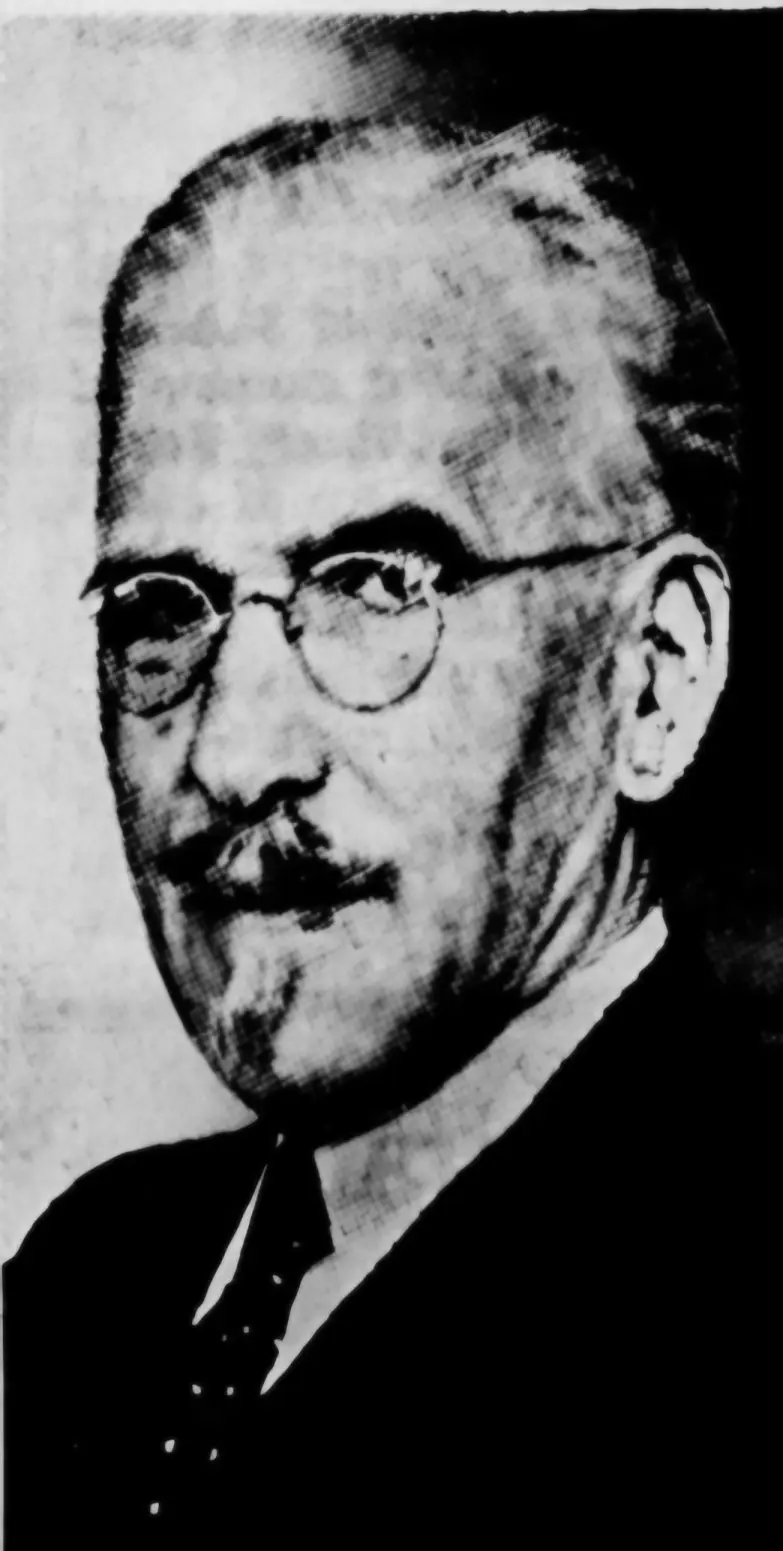
At 3:15 on the afternoon of Friday 24 March 1939, Charles Marega finished a lecture to his students at the Vancouver School of Art. He reached for his hat and coat, and he fell. Within minutes he was dead. He was 67.
Charles Marega designed the two concrete lions at the south end of the Lions Gate Bridge. They were the last big work of his life. He would have liked bronze or stone, but the budget was small, so they are concrete. They were hoisted onto their pedestals on 23 January 1939, two months before he died. Many websites give his death as 27 March 1939. The newspapers of the day say Friday 24 March.
Who was Charles Marega?
His obituary called him the maker of “most of the monuments” in Vancouver’s parks. He was born on 24 September 1871 at Lucinico, near Gorizia, then in Austria-Hungary. He studied sculpture in Zürich and Vienna and worked in South Africa. He reached Vancouver in October 1909.
He stayed for good. From 1925 he taught modelling and sculpture for the Vancouver School Board. He sat on the council of the Vancouver Art Gallery. When he became a Canadian citizen in 1926, he called the meeting of mountains and sea here “the widest sweep of beauty in all the world”.
His wife died in 1936. Parks Canada now lists him as a National Historic Person.
What else did Marega make in Vancouver?
A great deal of what stands in the city’s parks. His obituary in The Vancouver Sun listed the Harding Memorial and the bust of David Oppenheimer in Stanley Park. It added the King Edward fountain at the courthouse and the statue of Captain Vancouver at City Hall.
When he died he was planning a large monument to Vancouver’s pioneers, for Stanley Park.
How were the Lions Gate Bridge lions made?
Cheaply, and Marega minded. The commission came from A.J.T. Taylor, the bridge’s promoter and an old friend. Marega told his family in a letter that he would have liked bronze or stone, “but it has to be cheap”. So the lions would be concrete.
There was a tug of war over where to make them. One of the bridge’s engineers, a Montrealer, pushed to have them modelled in his home town, according to MONOVA, the museum and archives of North Vancouver. They were made in Vancouver.
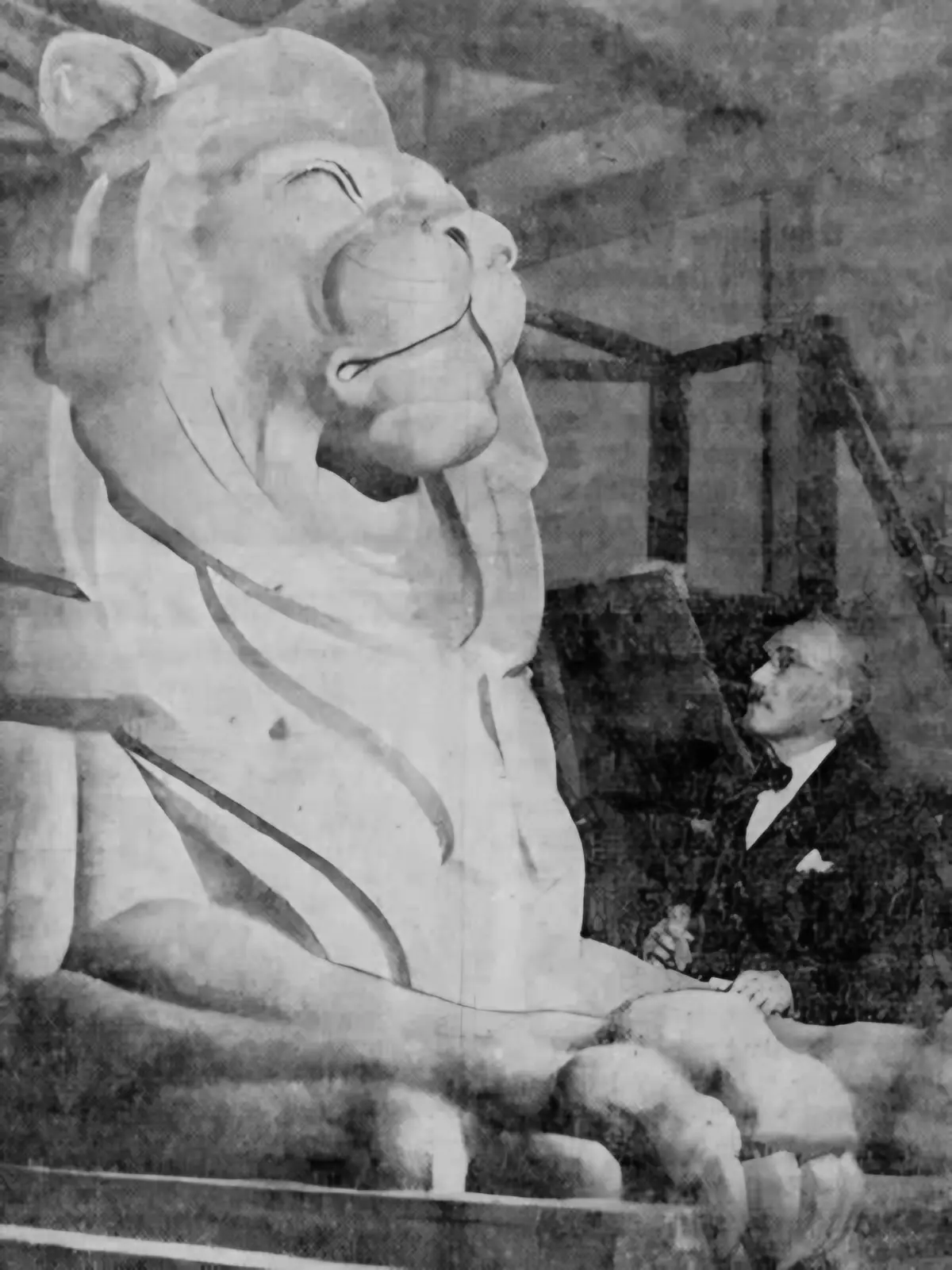
The contractor Stuart Cameron & Co. cast each lion in two parts, The Province reported: a body of six and a half tons and a two-ton head. Early on Monday 23 January 1939, derricks mounted on trucks lifted the bodies onto their pedestals, and the heads were set on afterwards. (The Province had spoken of “the crane crew” on the Friday before.) Marega was “just too nervous to watch”, the paper said. Two small concrete lions went to Taylor, for his summer house on Samuel Island.
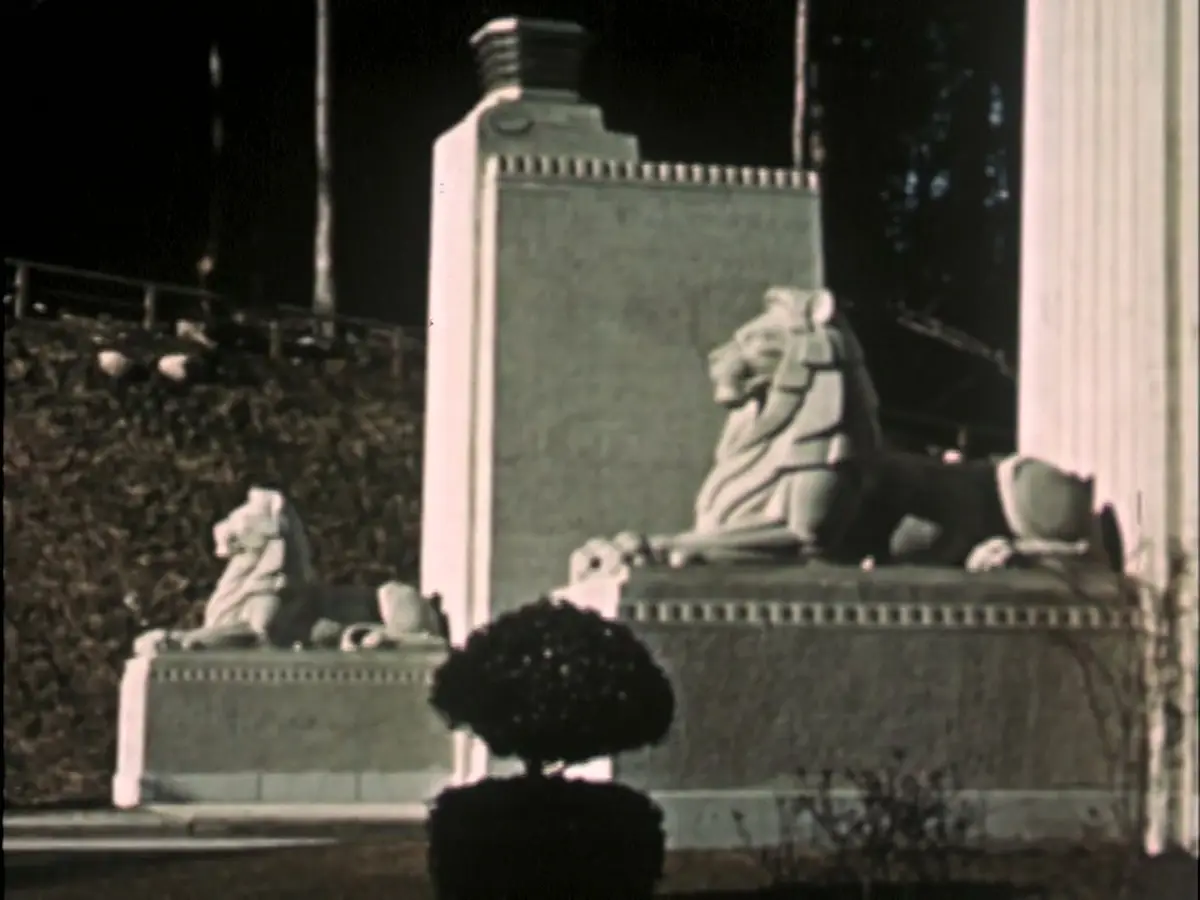
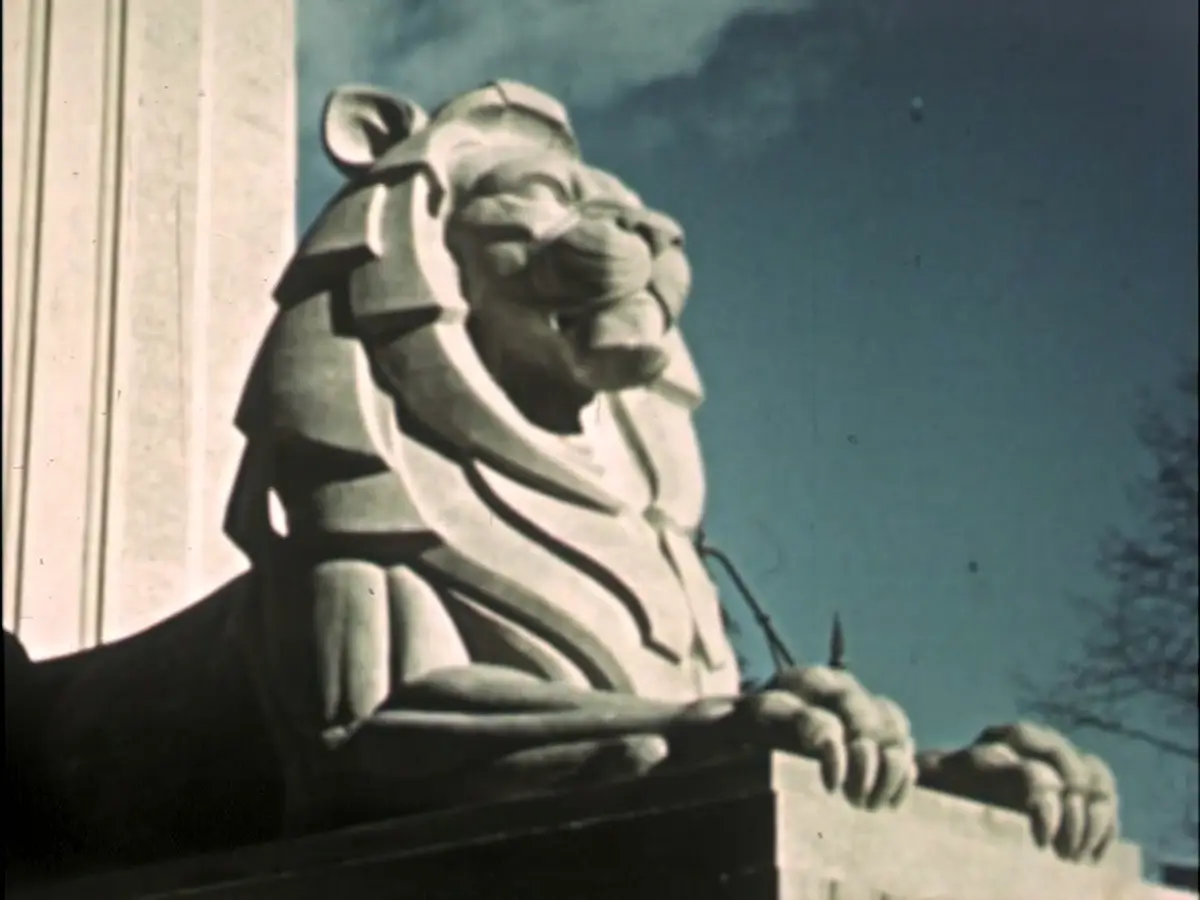
Look at the lions and you can see what Marega made of the material. They are not lifelike. They are Art Deco: the mane falls in flat, layered plates, like a stiff cape, and the face is squared off. Each lion lies on a broad base with its head up, like a sphinx, and its big front paws reach over the edge. Behind it rises a tall fluted pillar.
When were the lions put on the bridge?
On the morning of Monday 23 January 1939. Two derricks mounted on trucks lifted each lion onto its pedestal at the south entrance of the bridge. The Vancouver Sun and the Vancouver Daily Province both reported it that day.
The Sun printed a photograph of the lions with a caption. It called them the finishing touch to the span and said each weighed eight and a half tons, which matches the 1999 book’s figures of about 6.5 tons for a body and 2 for a head. W. F. Way, who supervised the job for Stuart Cameron & Co., told the paper it was a ticklish one. In the photograph a woman, Miss Lolita Copefield, stands beside one of the lions. The caption says she “may boast of being the first person to be photographed beside the massive lions”.
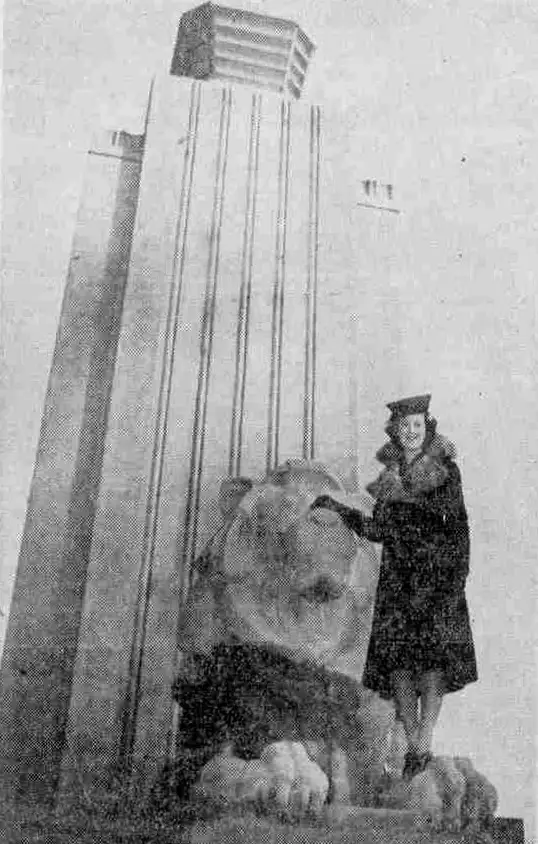
The Province wrote that Marega was among those not there: he was too nervous to watch, for fear that something might happen to his lions. It gave other weights, seven and a half tons for each lion, and said that the heads, two tons apiece, were set on afterwards.
The papers on either side of the day agree. On opening day, Saturday 12 November 1938, the Sun reported that the two big lions were “not ready yet”. Their pedestals were in place. On 25 March 1939, Marega’s obituary called them his latest work, “the two immense lions guarding the south approach” to the bridge. Later sources give the same day: the Sun’s This day in history columns say 23 January 1939, and a photograph published by the Vancouver Courier in 2019 is marked 25 January, two days after the lift.
When and where did Charles Marega die?
On Friday 24 March 1939, at the Vancouver School of Art. The Sun’s obituary, printed the next day, gives the time as 3:15 p.m., at the end of a lecture. A caption on the same page says “Friday noon”. We follow the story, which tells the moment in order. The Province, the same day, also said Friday afternoon.
The Canadian Press agrees on the day. Its report, datelined Vancouver, 24 March, says he died suddenly “late today” while teaching. Victoria’s Daily Colonist printed it on Saturday 25 March.
That settles it. A newspaper of 25 March cannot report a death on 27 March.
At his funeral on 28 March, A.J.T. Taylor, who had commissioned the lions, was one of the six pallbearers.
Why do some sources say 27 March?
We do not know, because none of them points to an original source. English Wikipedia’s infobox gives 27 March 1939, with no citation. Wikidata gives the same date and cites Wikipedia. A 2016 blog post gives 27 March, and an age of 68, without a source.
27 March 1939 was a Monday. It was not the day of the funeral either: The Province reported the service on Tuesday 28 March. We have found no source for 27 March.
The obituary has errors of its own, and they are a useful warning. It calls Marega “a Genoese by birth”; he was born near Gorizia. It says he was 63; the Canadian Press said 63 too, but he was 67. It says he came in 1910; most sources give 1909. The Province’s obituary that day repeats all three. A paper of the day is strong on the day. It is weaker on a life.
Are the lions still there?
Yes. They still guard the south approach, and the federal register of historic places counts them among the features that make the bridge a National Historic Site.
There are stories about them, too. Workers are said to have put coins under the paws, and a keepsake box inside one lion. We have found nothing to confirm any of it.
If someone asks you: Charles Marega designed the two concrete lions at the south end of the Lions Gate Bridge, hoisted onto their pedestals on 23 January 1939. He died at the Vancouver School of Art on Friday 24 March 1939, aged 67.
The lions went up in January. Their maker was gone by March.
Questions people ask
Who made the lions on the Lions Gate Bridge?
The sculptor Charles Marega designed the two concrete lions at the south end. A.J.T. Taylor, the bridge’s promoter, gave him the commission, and the contractor Stuart Cameron & Co. cast them.
When did Charles Marega die?
On Friday 24 March 1939, at the Vancouver School of Art, at the end of a lecture. The Vancouver Sun’s obituary and the Canadian Press both give that day.
When were the Lions Gate Bridge lions installed?
On 23 January 1939, early in the morning.
Are the Lions Gate Bridge lions made of stone?
No, they are cast concrete. Marega would have preferred bronze or stone, but the budget was tight.
How old was Charles Marega when he died?
He was 67. He was born on 24 September 1871; the 1939 newspapers wrongly gave his age as 63.
Notes and sources
Show
What we read from 1938 and 1939
- The Vancouver Sun, 20 September 1938, page 11, “They’ll Guard Mammoth Span”: the clay models and Marega, photographed by W. B. Shelly. The Vancouver Daily Province, 25 March 1939, page 10: his portrait, with the report of his death. We read these pages.
- The Vancouver Sun, 12 November 1938, page 16: the lions “not ready yet”, the pedestals in place.
- The Vancouver Sun, 25 March 1939, page 8, “Noted Local Sculptor Dies”: the time and place of death, the caption’s “Friday noon”, his works, his teaching, his 1926 words, the lions as his latest work, and the errors on birthplace, age and year of arrival.
- The Vancouver Sun, 23 January 1939, page 20, a photograph with a caption: the lions hoisted onto their pedestals “early today” by two derricks mounted on trucks, eight and a half tons each, Miss Lolita Copefield, W. F. Way of Stuart Cameron & Co.
- The Vancouver Daily Province, 20 January 1939, page 28, “Massive Lions Will Go Into Place Monday”: the lift announced for early Monday, the bodies of six and a half tons, the two-ton heads to be added after, the casting by Stuart Cameron & Co., “the crane crew”.
- The Vancouver Daily Province, 23 January 1939, page 14, “Massive New Lions Put Into Place on Span”: the lift that morning, Marega not there, the weights, the heads set on later.
- The Vancouver Daily Province, 25 March 1939, page 10, “Charles Marega Gained Fame For Many Works of Art Here”: “Friday afternoon”, with no time, and the same three errors on birthplace, age and year of arrival.
- The Vancouver Daily Province, 28 March 1939, page 26, “Final Tribute Paid to Charles Marega”: the funeral that day, and A.J.T. Taylor among the six pallbearers.
- We read these Sun and Province pages. We quote short lines and do not reproduce the pages. The one picture from them that we show is the photograph of Miss Copefield and the lion, from page 20 of the Sun.
- The Daily Colonist (Victoria), 25 March 1939, Canadian Press report datelined Vancouver, 24 March: “late today”. Free to read on the Internet Archive.
- A.J.T. Taylor, 1st Narrows Bridge, a 16 mm colour film of the construction, City of Vancouver Archives, AM1487-F07-: 2012-091.1, public domain: the title card “Sculptor Charles Marega’s splendid Lions guard the south approach”, then the lions, from about 39 minutes 57 seconds to 40 minutes 13 seconds into the archives’ master copy. Our pictures are the frames at about 39 minutes 59 seconds and 40 minutes 9 seconds. The archives dates the film 1937–38, but the lions were not ready on 12 November 1938, so this shot is later.
Later accounts we used
- MONOVA, “Building a Vancouver Icon”, the lions page (photograph NVMA 5302): Marega’s letter, “but it has to be cheap”, Taylor’s commission and the Montreal engineer.
- Lilia D’Acres and Donald Luxton, Lions Gate (Talonbooks, 1999), pages 129–130: the lions for Samuel Island. The casting, the weights and Marega’s nerves are in the Province pages above; the book agrees.
- Wikipedia, “Charles Marega”: birth date and place, arrival in October 1909, and the 27 March date in the infobox. Wikidata, item Q5080654. Eve Lazarus, “The work of Charles Marega (1871–1939)”, 26 March 2016.
- The Vancouver Sun, “This Day in History” columns of 23 January 2012 and 16 January 2026, and Miss604, 23 January 2012: also 23 January 1939, the day the papers of 1939 give.
- Vancouver Courier, “Here be lions”, 2019: the photograph marked 25 January 1939.
- Chuck Davis, “Charles Marega”, The History of Metropolitan Vancouver, as cited by Wikipedia: the lions placed in January 1939.
- Glenn Tkach, “The Lions Gate Bridge – and the Lions Who Guard It”, Forbidden Vancouver, 2019: the weights, and the stories about coins and a keepsake box.
- Parks Canada, “Charles Marega National Historic Person”; Canadian Register of Historic Places, “Lions Gate Bridge National Historic Site of Canada”: the lions as character-defining elements.
Our readings
- The date of the lift, 23 January 1939, is not our reading: the Sun and the Province of that day report it.
- That the obituary’s 3:15 p.m. beats its own caption is our judgement. The Province of the same day also says “Friday afternoon”, but gives no time.
- What the lions look like is our own description, from the lion shots in Taylor’s film.
Spotted a mistake? Tell us at [email protected]. We correct the page and note the date.