
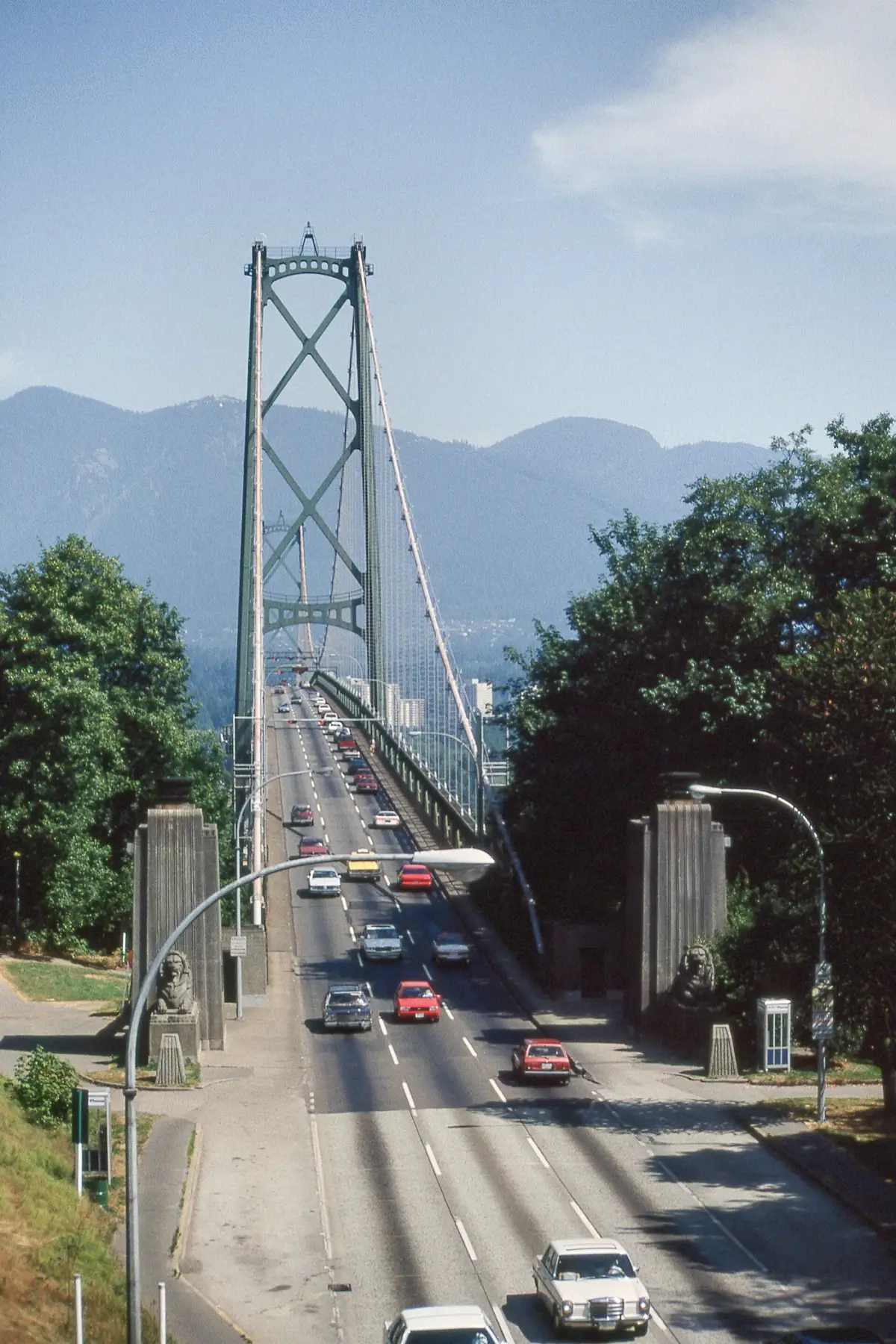

At about half past nine on a weekday morning, an operator in a control room changes the lights over the middle of the Lions Gate Bridge. The lane clears, and the green arrows turn to point north. Two lanes that carried the North Shore into Vancouver become one. By our count of the lane signals, the middle lane changes direction about 30 times on a typical day.
The Lions Gate Bridge has three lanes because its 1938 deck only had room for three narrow ones, and because every later plan for a fourth lost a supporter. When the deck wore out, the province asked in 1997 for a four-lane crossing. Vancouver would not take more rush-hour cars. The Park Board would not give up more of Stanley Park. The North Shore would not pay tolls. So in 2000 and 2001 the deck was rebuilt with three lanes again, only wider.
How many lanes did the Lions Gate Bridge have in 1938?
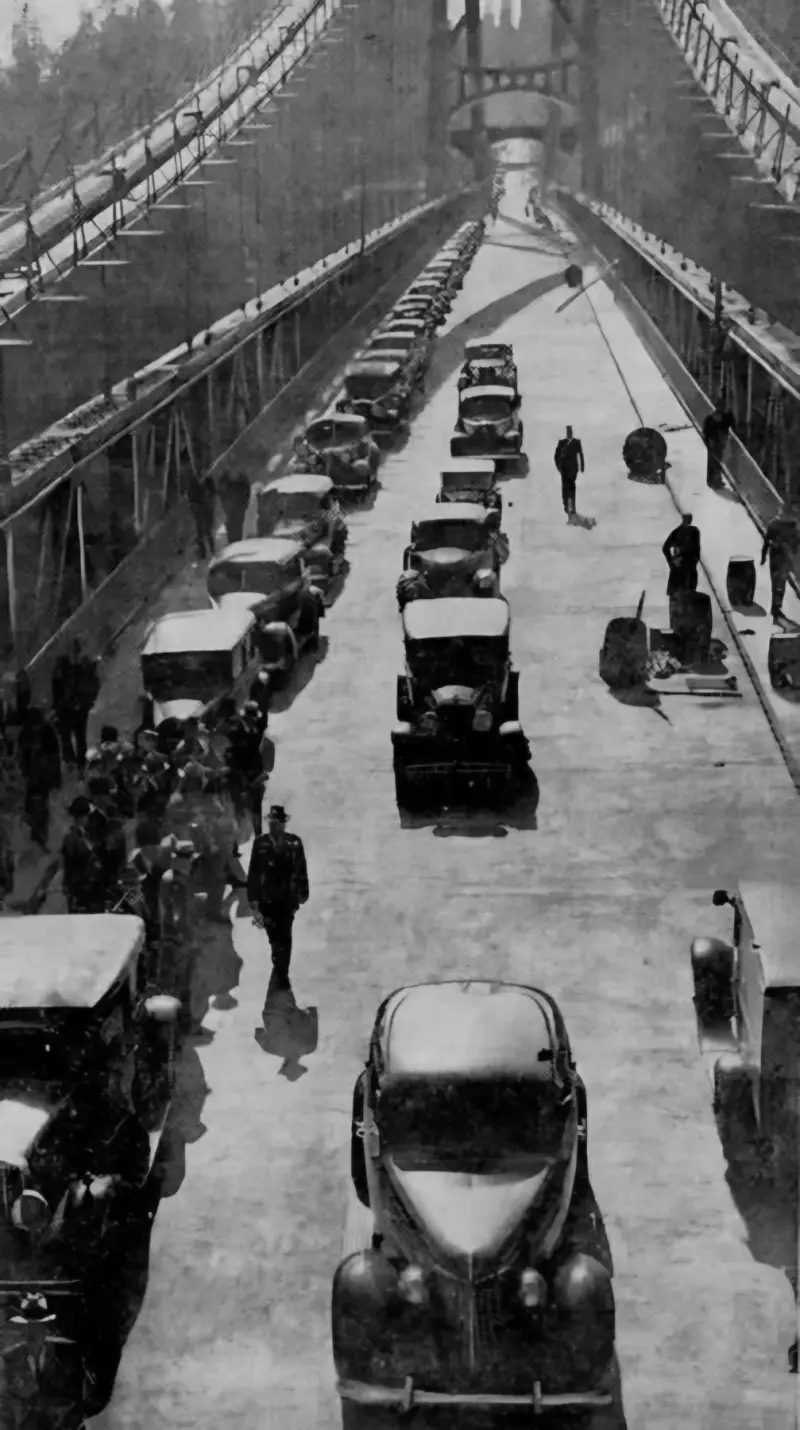
Two. The road between the curbs was about 29 feet wide, and a yellow line ran down the middle. The bridge company’s manager, Major P. A. Curry, said it could become three lanes if traffic grew, The Province reported on 29 September 1938.
A private company built the bridge and paid for it with tolls. It built no more road than it needed. Darryl Matson, an engineer at Buckland & Taylor, the firm that later designed the rebuild, put it this way in 2009: the only allowance for the future was that “three narrow lanes could be squeezed between the curbs”.
When did the bridge get a third lane?
On Monday 19 May 1952. That spring, a two-week count found about 1,800 vehicles an hour at the morning peak, the Sun reported. Over the weekend before, painters marked the bridge and the park road into three lanes of 10 feet.
At rush hour, roadside signs gave the middle lane to the busy direction. Two motorcycle police decided each day which way it ran. Without the signs, the Sun explained, the bridge stayed a two-lane road. The change cost about $18,000.
In 1965 signal lights took over the middle lane. That was the start of the counterflow system: two lanes one way, one lane the other.
Why not just add a fourth lane?
Because a suspension bridge cannot simply be made wider. Its deck hangs from two main cables and passes through two towers. “A suspension bridge deck is restricted to the width between the tower and cables,” Mike Belyea wrote in 1998, in a Simon Fraser University thesis on the choice.
To carry four lanes, the old bridge would have needed new cables, a new deck and stronger, taller towers. The options put to the public in the 1990s priced that at $100 million to $300 million. A new deck with three wider lanes would cost about $70 million.
Bigger ideas came and went. In November 1954 the bridge company offered to build a $17 million twin just east of the bridge. A 1958 study set 1966 as the target for a four-lane suspension bridge. Neither was built.
What did the province ask for in 1997?
Four lanes. A 1995 study had found the bridge safe only until 1999. The province had opened a public consultation in 1993. It received over 1,000 submissions and 21 proposals: new bridges, twin bridges, double decks and tunnels.
On 18 April 1997, the Transportation Minister, Lois Boone, asked private companies to design, build and finance a new crossing. It was to carry “four lanes of traffic, two northbound and two southbound”, with a tunnel favoured under Stanley Park. The province would put in up to $70 million, the cost of rebuilding the old bridge. Tolls would pay for the rest.
Who said no to four lanes?
Three groups, each to a different part of the plan.
Vancouver did not want more cars. In 1992 its council had resolved that there be “no further significant investment to expand motor vehicle capacity into Vancouver”. The province answered that its four lanes would add no rush-hour capacity into the city, only a lane in the other direction.
The Park Board did not want a wider road through Stanley Park. In July 1996 it called a bored tunnel “the only acceptable way of achieving a widened roadway through the park”. A tunnel would cost far more than $70 million, and tolls would have to pay for it.
The North Shore did not want tolls. In August 1997 the minister floated a toll of up to $2, the North Shore News reported. The North Shore councils said they had not been properly consulted about tolls. That November, a North Vancouver chamber of commerce survey found 87 per cent of 205 drivers against one.
The province had a way out. It had said it would rebuild the old bridge with three lanes if local governments could not agree. In 1998 it did. Belyea wrote that July that if the North Shore would not accept tolls, the government would “have to opt for a three-lane rehabilitated bridge”. Then: “This is what the government has recently decided.”
Our reading is that three lanes was nobody’s first choice. Belyea interviewed people on 13 sides of the debate, and most of them preferred four lanes. Three lanes was the option still standing when the others had lost a supporter. As he put it, “one could end up with the same thing one started with: a three-lane bridge.”
What changed when the deck was rebuilt in 2001?
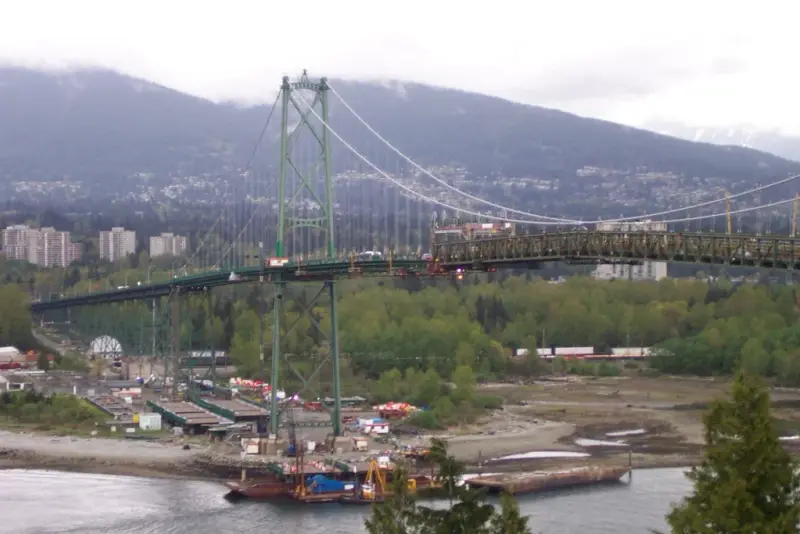
The lanes got wider, and people on foot moved out of the way. In April 1999 the province gave the contract to American Bridge and Surespan for $86.5 million. From the night of 9 September 2000, crews lifted out the old deck a section at a time and set in new ones, closing the bridge at night and opening it again each morning. The last of 54 sections went in on 29 September 2001.
The lanes went from 2.9 metres to 3.6 metres wide. The sidewalks went from 1.3 to 2.7 metres and moved to the outside of the bridge. The new deck was about 35 per cent wider but no heavier, so the towers, main cables and anchorages from 1938 did not need to be strengthened.

How does the middle lane work today?
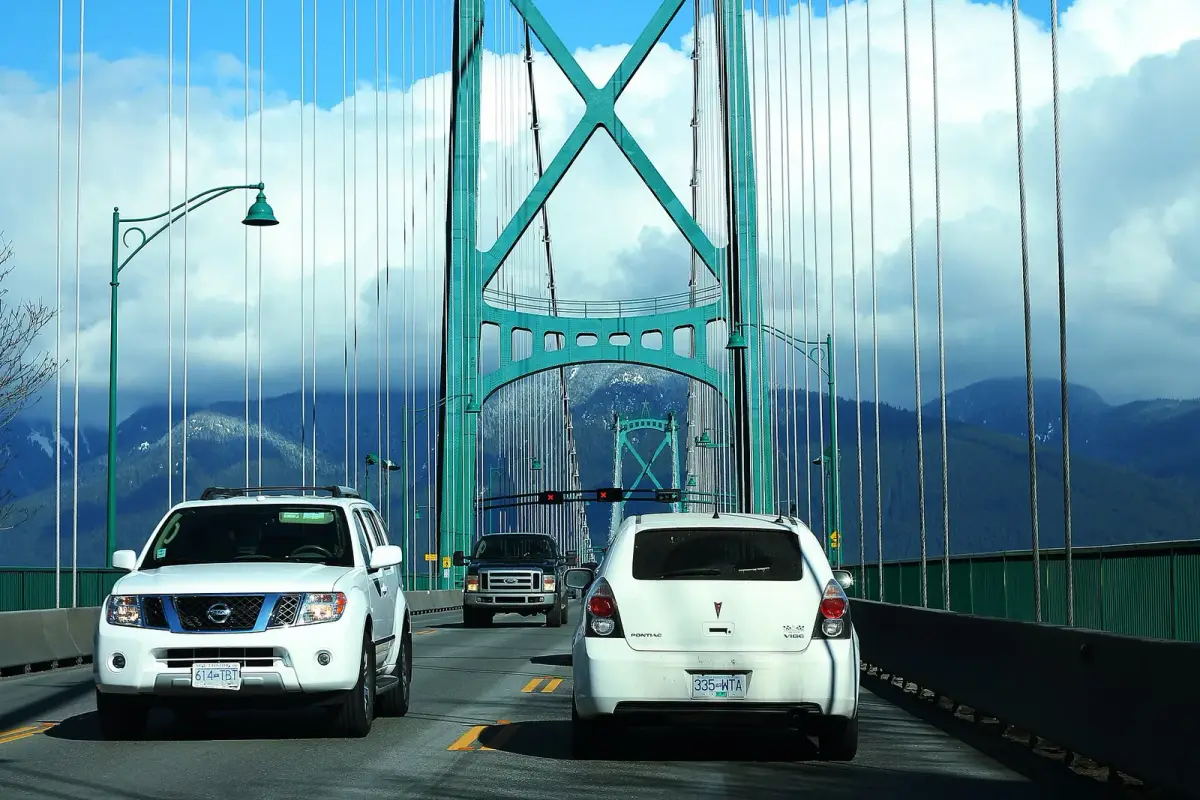
By hand. Operators at the Transportation Management Centre of BC watch the bridge on cameras and change the signals as traffic builds, TranBC, the transportation ministry’s blog, explained in 2019. On weekday mornings two lanes run south from about 6 a.m. At about 9:30 two run north. After that, the traffic decides.
In 2021 the province announced a $4.7 million upgrade of the signals and cameras. Its counter at the south end recorded an average of 56,582 vehicles a day in 2025. Our traffic page shows which way the middle lane runs now, and when it may change next.

If someone asks you: The Lions Gate Bridge has three lanes because its 1938 deck only had room for three narrow ones. In 1997 the province asked for four, but objections from Vancouver, the Park Board and the North Shore left three, rebuilt wider in 2001.
Four lanes were planned. Three were rebuilt. The middle one keeps changing its mind.
Questions people ask
Why does the Lions Gate Bridge only have three lanes?
Its 1938 deck had room for three narrow lanes. In 1997 the province asked for a four-lane crossing, but Vancouver opposed more rush-hour traffic, the Park Board a wider road through Stanley Park, and the North Shore tolls. The deck was rebuilt in 2000–2001 with three wider lanes.
Has the Lions Gate Bridge always had three lanes?
No. It opened in 1938 as a two-lane road, divided by a yellow line. A third lane that changed direction at rush hour began on 19 May 1952, and signal lights took over the middle lane in 1965.
How does the middle lane of the Lions Gate Bridge work?
Operators at the Transportation Management Centre of BC change the lane signals by hand, watching the bridge on cameras. By our count of the signals, the middle lane changes direction about 30 times on a typical day.
Will the Lions Gate Bridge be widened?
We have found no government plan to widen or replace it since the deck was rebuilt in 2001. When four lanes were last studied, in the 1990s, they meant new cables and stronger, taller towers.
How many vehicles cross the Lions Gate Bridge a day?
An average of 56,582 a day in 2025, at the province’s counter at the south end of the bridge.
Notes and sources
Show
What we read from the time
- The Vancouver Daily Province, 29 September 1938, front page: the yellow line, and Major Curry on a third lane if traffic grew. The Vancouver Sun, 30 September 1938, page 2: the deck wide enough for three lanes, divided into two. The photograph of the first cars is from the front page of the Sun of 6 October 1938.
- The Vancouver Sun, 19 February and 8 May 1952, and The Vancouver Daily Province, 17 May 1952, read as clippings on Newspapers.com: the three-lane plan, the signs, the two motorcycle police, the three 10-foot lanes, the cost of about $18,000 and the traffic count.
- The Vancouver Sun, 13 November 1954, front page: the company’s $17 million twin. The Vancouver Sun, 13 November 1997: the toll survey. We read the 1938, 1954 and 1997 pages in a subscription newspaper archive (ProQuest). We quote short lines and do not reproduce the pages.
- North Shore News, 20 August 1997: the toll of up to $2.
- City of Vancouver, Engineering Services, “Status of Lions Gate Crossing”, report of 30 April 1997: the council resolution of 4 September 1992, the Park Board motions of 1993 to 1997, and the province’s announcements of 16 and 18 April 1997, with the four-lane condition and the $70 million.
Later accounts we used
- Mike Belyea, “The Choice of Alternatives in the Replacement of the Lion’s Gate Bridge”, MA thesis in geography, Simon Fraser University, July 1998: the consultation from 1993, the 1995 safety finding, the width of a suspension deck, the 1,000 submissions and 21 proposals, the short-listed options and their costs, the province’s fallback to three lanes, its 1998 decision and the 13 case-study interviews.
- Darryl Matson, Buckland & Taylor, “The Lions’ Gate Bridge Suspended Span Replacement”, Transportation Association of Canada, 2009: two lanes in 1938, the signals of 1965, the 1999 contract, the night closures, the 54 sections, the lane and sidewalk widths, and the weight of the new deck.
- Lilia d’Acres and Donald Luxton, Lions Gate (Talonbooks, 1999): page 153, the 1958 study; and the province’s 1998 choice of a three-lane rebuild.
- MONOVA, “Building a Vancouver Icon: The Lions Gate Bridge”: the sidewalks moved to the outside of the bridge.
- TranBC, “How the Lions Gate Bridge Counterflow Works”, 29 August 2019 (now in the Wayback Machine): the operators and the weekday pattern.
- BC Gov News, “System upgrade coming to Lions Gate Bridge counterflow”, 25 May 2021: the $4.7 million upgrade.
- BC Ministry of Transportation and Transit, TRADAS count site P-15-1NS, south end of the bridge: 56,582 vehicles a day on average in 2025.
Our count of lane changes
- The Museum records the lane signals every few minutes. Over 219 complete days from 19 February to 6 November 2026, the median was 29 changes of direction a day. A change is a switch from one open direction to the other, directly or through a closure shorter than 20 minutes. Over 206 days to 22 October, the mean was 29.9, the figure in our press release. “About 30” rounds both.
Our readings
- That three lanes was nobody’s first choice is our reading of Belyea’s interviews and of the province’s 1997 call for four lanes.
- Matson and MONOVA date the three 2.9-metre lanes to 1954. The 1952 papers describe three 10-foot lanes from May 1952. We take 1952 as the start of three-lane use; 1954 may be a later repainting.
Spotted a mistake? Tell us at hello@lionsgatebridge.org. We correct the page and note the date.